

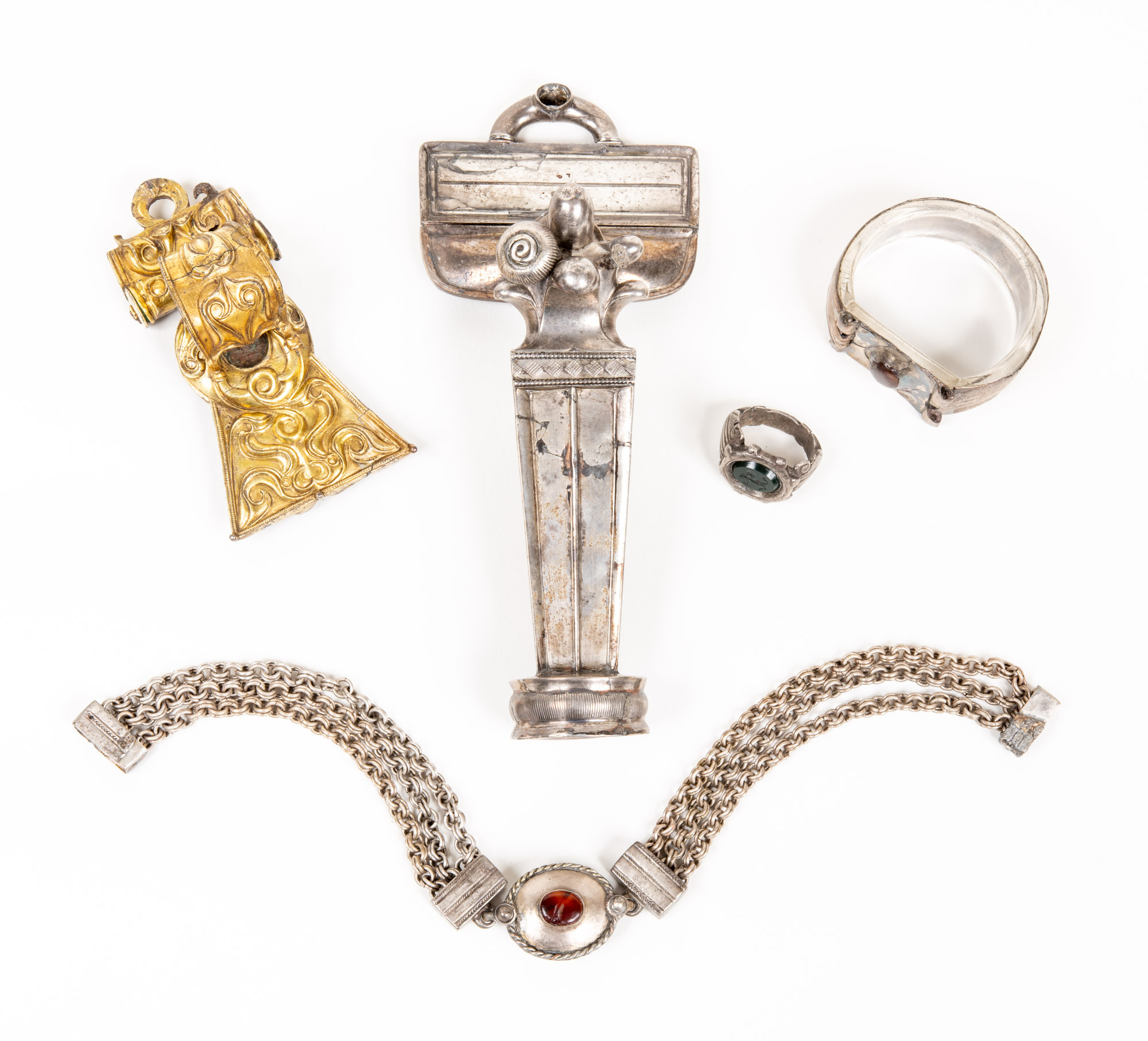
In troubled times on the northern Roman frontier, a jewellery hoard was buried under the floor of a guard house on Hadrian’s Wall in Northumberland.
As is often the case with such buried deposits, the Third Century owner of the brooches, rings, necklace and bracelet at Great Chesters fort near Haltwhistle never retrieved their property.
“These were unsettled times with a lot of conflict,” said Andrew Parkin, keeper of archaeology at the Great North Museum: Hancock in Newcastle.
What is known as the Aesica hoard is one of a series of similar buried items which will go on show in a major exhibition which explores the depth of history in the North East over thousands of years from the Bronze Age to Tudor times.
The exhibition, titled Treasures Hidden, Lost, Found will open on March 28 at the museum, until September 20.
It will draw on the hundreds of thousands of finds from the past which are housed at the museum – many of them in storage – and which are mostly owned by the Society of Antiquaries of Newcastle upon Tyne.
There will also be objects with regional links from the British Museum and the National Museum of Scotland.
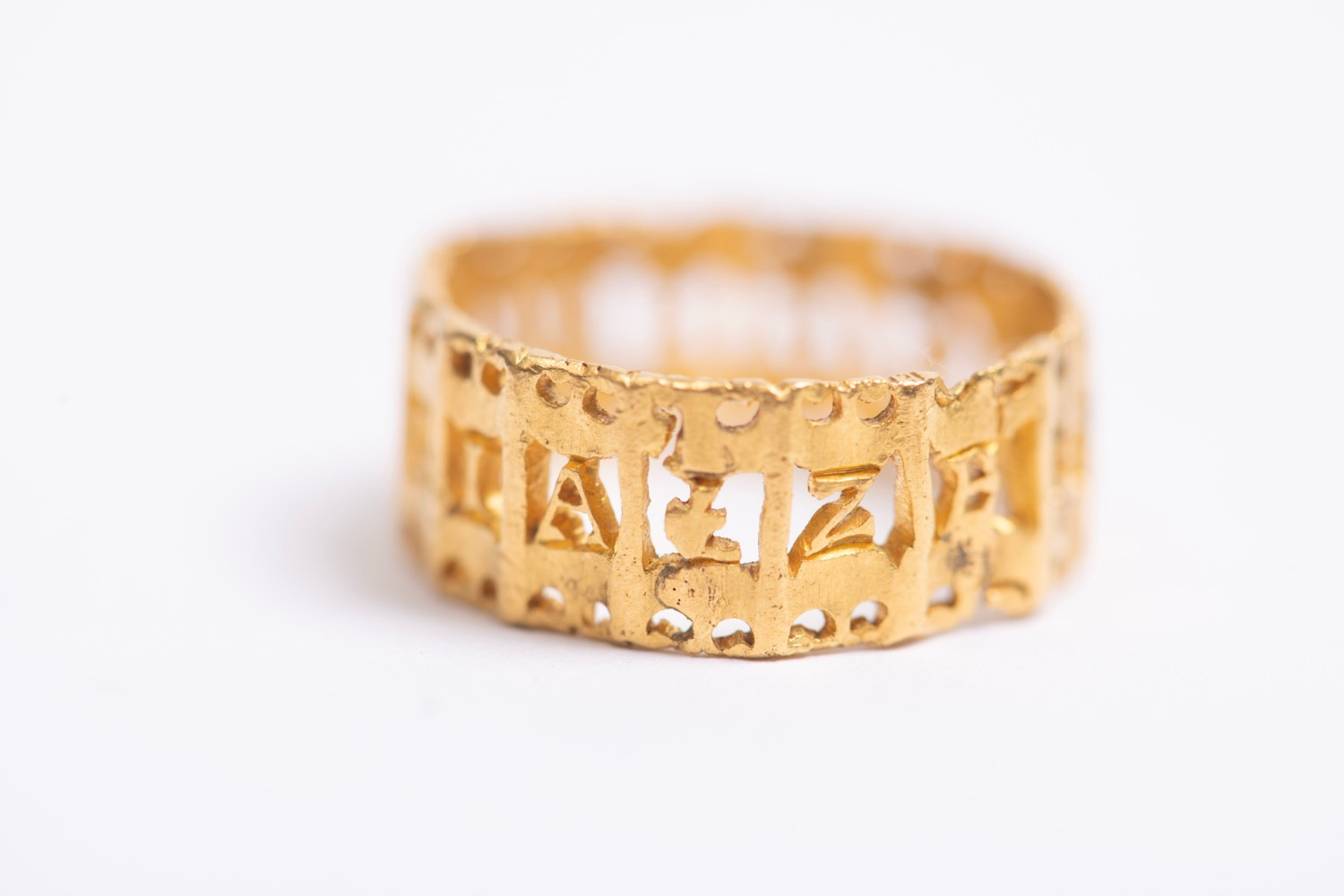
Individual items include the Roman gold Aemilia finger ring found at Corbridge in 1840.
It is inscribed with the letters AEMILIA ZEBES, meaning Aemilia may you live. It was probably made in one of the Greek provinces of the Roman Empire and may be the earliest Christian artefact to have been found in Britain. It may also have been a love token or betrothal ring.
Also on show from Berwick Museum will be the Ord cross, an inch-long rare Anglo-Saxon gold cross pendant, inscribed with its owner’s name, Eadruf.
It was lost on the banks of the River Tweed for about 1,000 years and was discovered by a metal detectorist in 2020.
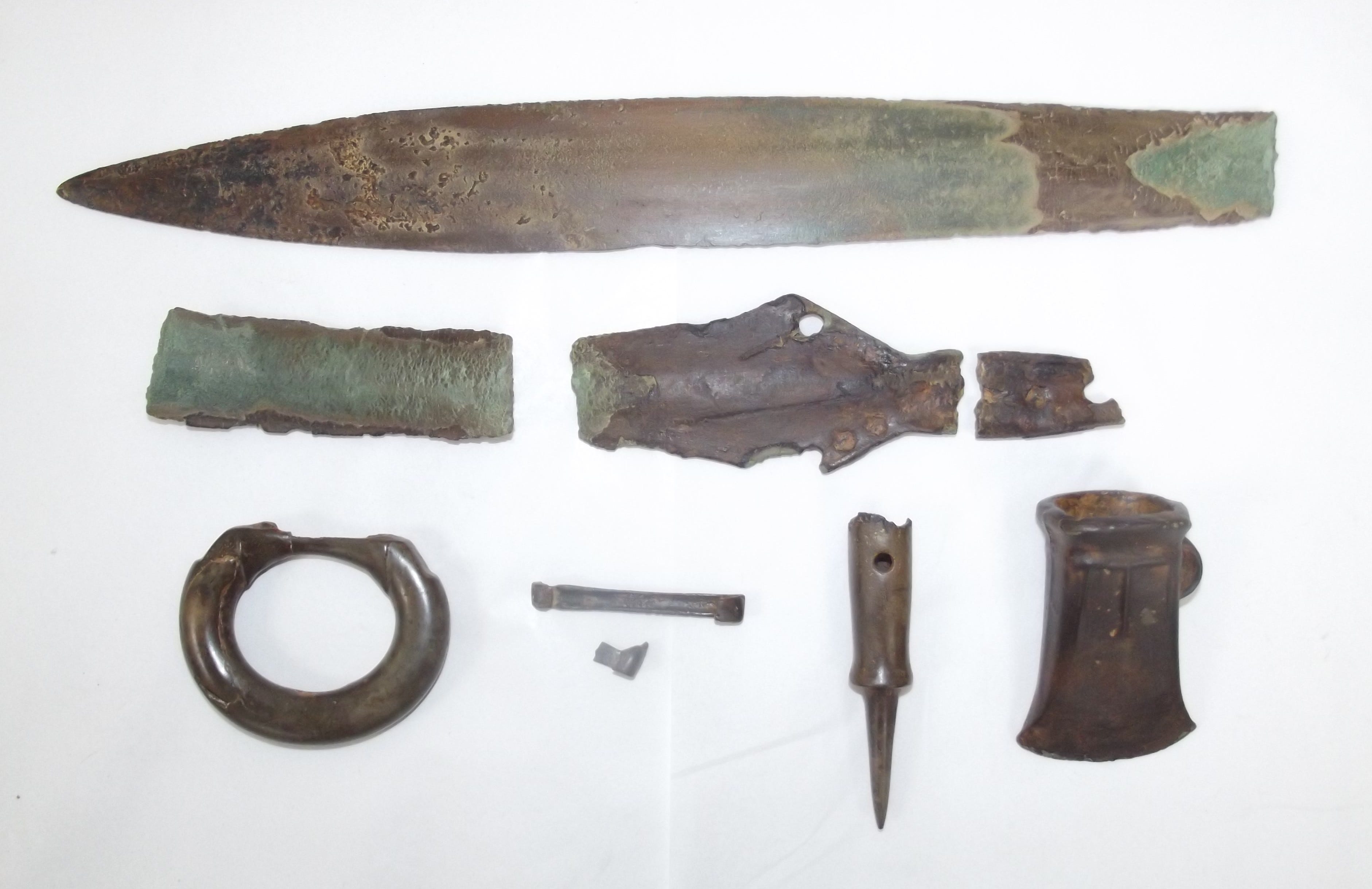
Another detectorist find is the Collette hoard which was discovered in fields near Berwick in 2005 and named after his daughter Collette.
The Bronze Age hoard included six gold lock rings, believed to have been hair decorations, bracelets, rings and pins, and also six socketed axes which could have been used either for woodworking or as weapons, and the first socketed gouge – a tool which would have been used by craftsmen – to be found in Northumberland.[2]
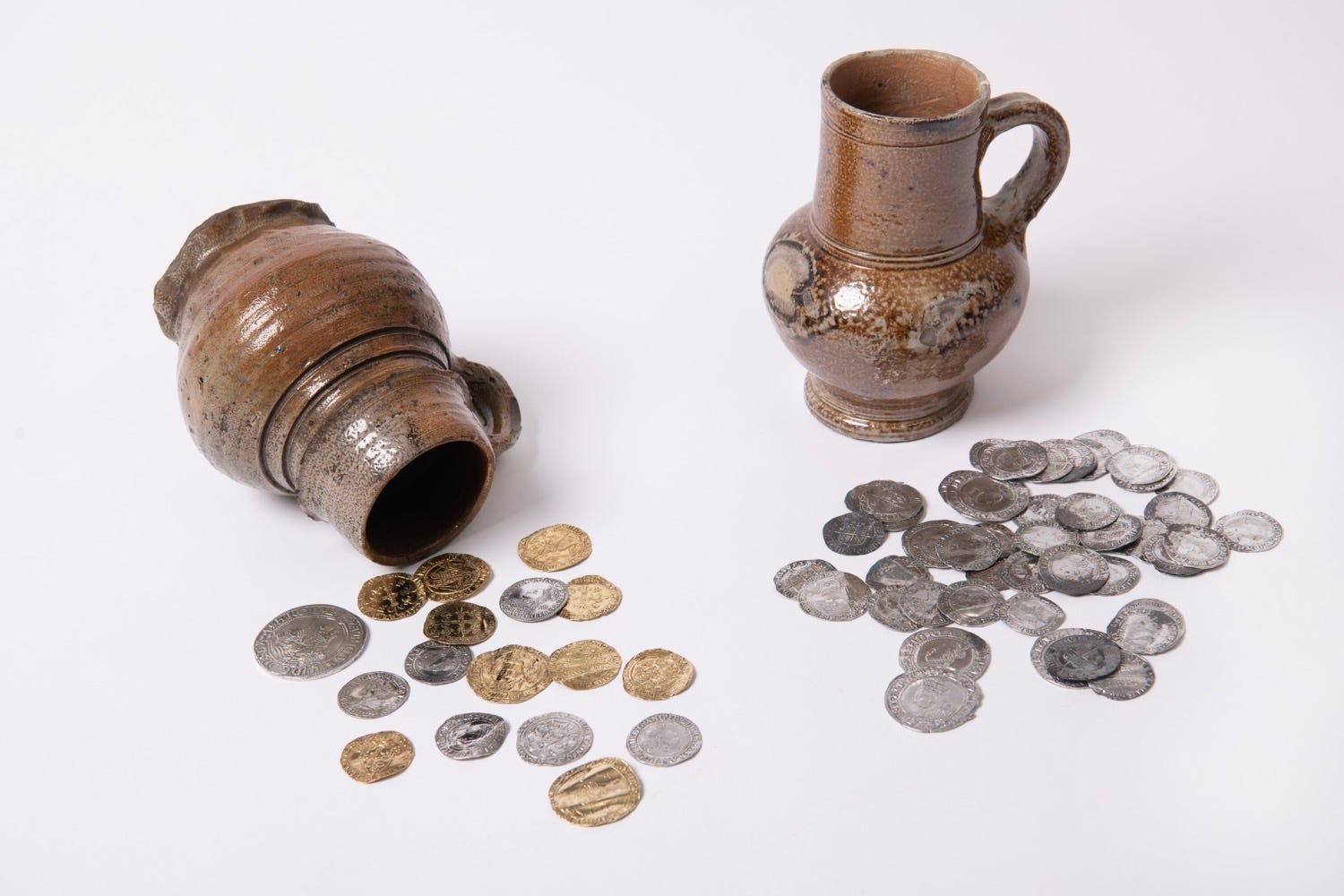
Whoever buried a hoard of gold and silver coins at Lindisfarne in Northumberland more than 450 years ago was the toast of the two builders who found the treasure.
When Richard Mason and father Tom realised that the earthenware pot contained the coins they washed out the vessel.
“We filled it with beer and drank to the person who hid it,” said Richard at the time. The find was installed at the Great North Museum after almost £5,000 in public donations flowed in when the Society of Antiquaries was given a fixed time to raise the funds to buy the hoard for the region.
It went on show in 2014 at the museum alongside a similar pot full of silver coins which were found at the same spot in 1962.
It is believed that the pots, which both had a latest-date coin of 1562, were buried or hidden by the same person underneath a floor who could have been part of the garrison of Lindisfarne Castle.
The 1962 find consisted of 17 silver British coins, from the time of Mary I, Elizabeth I and Mary Queen of Scots.
The later hoard was of 50 coins of English, French, Spanish-Dutch and German origin and spanned the reign of six sovereigns of England.

A hoard of gold and silver objects, found in 1812 near Backworth, now North Tyneside, was sold to a Newcastle collector, from whom most of the objects passed in 1850 to the British Museum.
The hoard consisted of silver skillets, or pans, in which were a pair of silver-gilt trumpet brooches, one silver and five gold rings, a gold bracelet, two gold chains, three silver spoons, and 280 Roman coins with a likely deposit date of A.D. 140.
The larger skillet and one of the gold rings each have a dedication to the mother-goddesses.
The Tribley Shield was one of the first objects to be donated to the Society of Antiquaries in 1813.
The bronze shield remained buried and intact for thousands of years before it was unearthed in the 18th century by a farmer near Chester-le-Street. It was split into three pieces so its metal could be shared among friends.
Two of the pieces were reunited and used in the re-creation of the shield.
The Birnie hoard of Roman coins from Elgin in Scotland was discovered in 1996 by a metal detectorist, with more found in 2000 within a pottery vessel. Totalling 315 coins, the hoard had been buried just outside the wall of a large Iron Age roundhouse.
In 2001, a second hoard made up of 310 coins in two small leather bags – also packed in an Iron Age pottery vessel – was discovered nearby.
Andrew Parkin said that the find pointed to contact between the Romans on Hadrian’s Wall and northern tribespeople beyond and could possibly have been payment to keep the peace.
Malavika Anderson, museum manager at the Great North Museum: Hancock, said, “We are delighted to unite these incredible archaeological finds from across the North for our latest exhibition.
“From Roman silver discovered along Hadrian’s Wall to Ninth-century gold found by a Newcastle University student, this is a rare opportunity to see these scattered treasures displayed alongside one another.
“People can experience the thrill of these finds and the fascinating stories they reveal about our shared past.”
The exhibition traces the journey of each object, exploring how and why these treasures were buried, the stories behind their discovery, and how they have been owned and valued over time.
Andrew Parkin said, “This exhibition provides us with a great opportunity to tell some of the exciting treasure stories from our region and beyond.
“I’m especially pleased we are able to display some impressive treasure finds from Scotland, like the Birnie coin hoard, that help tell the story of Rome’s northern frontier, shedding light on Roman relationships with peoples living north of Hadrian’s Wall.
“The exhibition also gives us the chance to display some of our own impressive treasures alongside items from the British Museum, highlighting the strength of the archaeological collections in the Great North Museum: Hancock.”
Details on https://www.northeastmuseums.org.uk/greatnorthmuseum/whats-on/treasure-hidden-lost-found