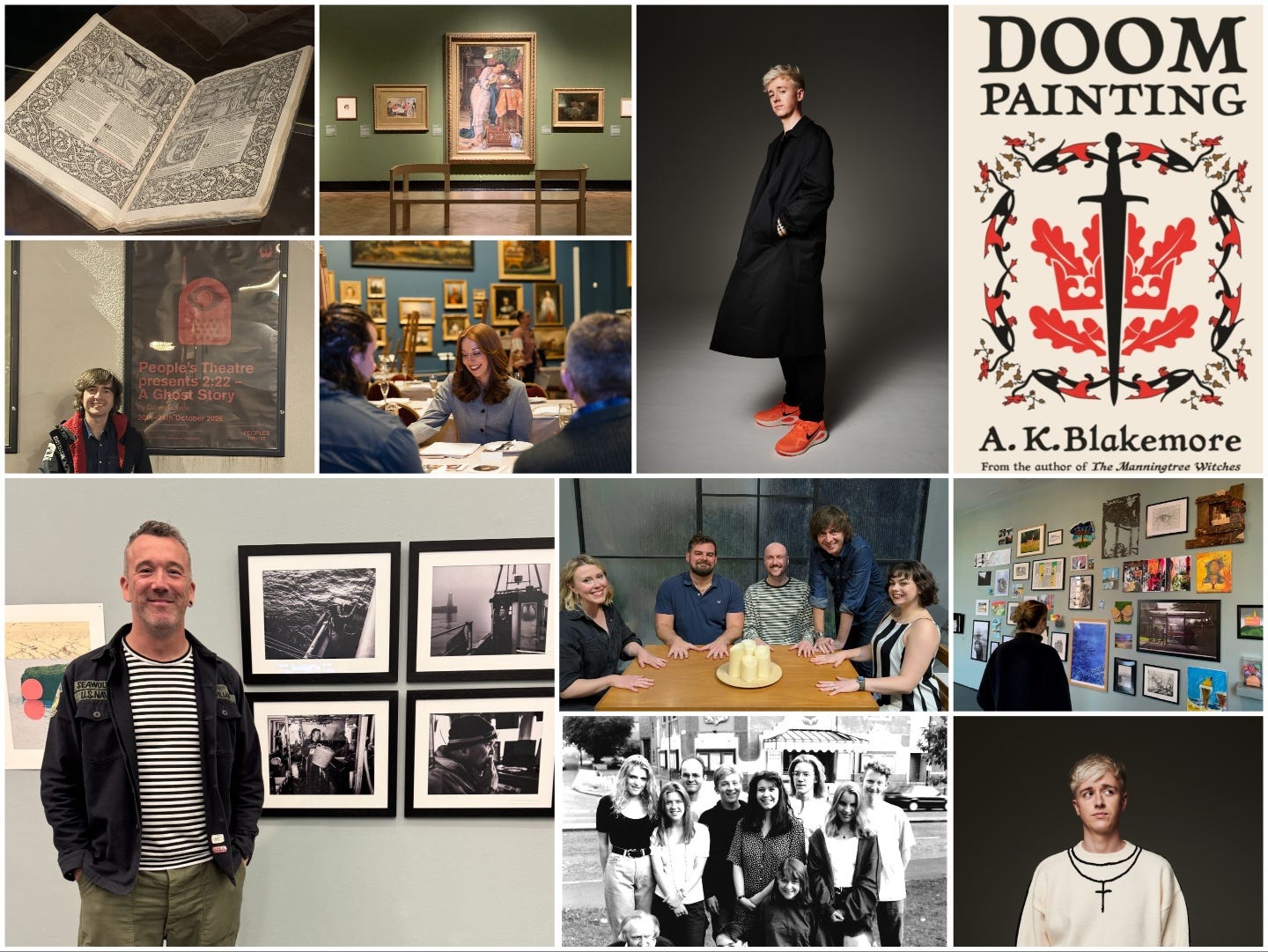
There’s art, comedy, a ghost story and plenty of opportunities to get creative in this week’s Cultured. On Sunday.
David Whetstone has been doing the gallery rounds, taking in the Baltic Open Submission exhibition, already shaping up to be one of the Gateshead gallery’s most popular of the year, and Pre-Raphaelites: Art and Poetry, the latest ticketed offering at Newcastle’s Laing Art Gallery.
He’s been catching up with the People’s Theatre too, where rehearsals for 2:22 A Ghost Story received a visit from a familiar face this week. The play’s creator (and supernatural-exploring superstar) Danny Robins, is a former member of the Newcastle theatre and dropped by to show his support.
We’ve been talking heartbreak, romantic comedies and the funny side of life’s disasters with comedian Daniel Foxx, who’s bringing his latest stand-up show to three North East venues this month.
Collected Books return with another recommendation for your bookshelf, while Get Stuck In heads to The Bowes Museum for a look at its after-dark programme of painting, making, exploring and more.
Plenty to keep you occupied. Happy Sunday!
Pre-Raphaelites celebrated in art, craft and poetry

Beautiful pictures, an abundance of wistful expressions, lots of poetic words… and a testy grumble from William Morris.
“If a chap can’t compose an epic poem while he’s weaving a tapestry… he had better shut up. He’ll never do any good at all.”
Yes, sir!
Better get weaving… and composing.
This admonition from the Arts and Crafts movement’s leading light is on the caption beside one of the most eye-catching exhibits in the latest ticketed exhibition at the Laing Art Gallery, Pre-Raphaelites: Art and Poetry.
It’s the Forest tapestry, produced by Morris & Co. in 1887 and featuring a peacock, a lion and other animals among abundant foliage, all beneath lines of verse by Morris.
On loan from the Victoria and Albert Museum (V&A), it looks – no kidding – as vivid and fresh as it must have done when it left the loom.
‘Uncanny’ Danny appears as 2:22 A Ghost Story casts a chill

Making an appearance – of a social rather than a spectral nature – at the dress rehearsal of 2:22 A Ghost Story at the People’s Theatre on Friday night was none other than the man who wrote it.
Captured on camera was Danny Robins… very much in the flesh and all smiles. How uncanny! Or, rather, Uncanny, as Danny’s hit radio/podcast/TV series is known.
When the spooky stage play was made available to amateur theatre groups for a limited period, you could almost bet your house (haunted or otherwise) on the People’s Theatre going for it.
For one thing, it has been a big hit in the West End, on tour and around the world since its premiere in 2021, and has also won and been nominated for a clutch of awards.
It holds the promise of an entertaining night out – if you like being on the edge of your seat - and good business at the box office.
But there was another reason why the Heaton-based amateurs would want to apply for the rights.
Danny, writer, performer, broadcaster and leader of the pack when it comes to sharing and investigating (supposedly) real-life tales of the paranormal, is one of the People’s Theatre’s talented alumni.

Baltic Open puts North East creativity on display

The call went out for creative people across the region to produce evidence of their creativity and here it is – Baltic Open Submission 2026, already shaping up to be one of the most popular exhibitions of the year.
Across two rooms equal prominence is given to the professional and the amateur, the seasoned and the fully fledged.
There was no given theme and the submissions, in whatever form, didn’t have to be fresh off the easel or out of the kiln, or indeed hot off the press, the call being for creative work in all media.
The appeal to visitors, already entering the ground floor in a steady trickle on Wednesday morning, lies in the variety… and the element of surprise.

Finding the funny side of heartbreak

Daniel Foxx had every intention of handling his big breakup with the grace and dignity of Julia Roberts in a 1990s romantic comedy.
Unfortunately, things didn’t quite go to plan. On the plus side, it gave him plenty of material for his new stand-up show, How Lovely.
“The grotesque answer is: immediately. Maybe even before it happened,” says the comedian when asked how long it took to spot the comic potential of his romantic misfortune.
“When you’ve done standup for a while, every single tragedy and drama in your life is tainted by the slight background thought of ‘oh this could be a good story.’ You’ll be mid-crashing your car thinking ‘yeah I could probably make a joke out of this.’”
The resulting show, which visits Newcastle, Sunderland and Barnard Castle this month, explores the realities of dating in your 30s, alongside Le Creuset addiction, elaborate skincare routines and the considerable gap between romantic expectations and reality.
Much of the blame, Daniel suggests, lies with the films that taught a generation what falling in love was supposed to look like.
“I’m sort of using 90s rom-coms to point out how we’re taught ‘Love’ and ‘Relationships’ will look - and how horrifying it is when you get out there and realise the truth.
“We’ve lost the art of the rom-com in the last 20 years, and I wonder if that’s because neither rom nor com can possibly come from staring down the barrel of Tinder.”


Founded by Emma Hamlett, Collected Books is an independent bookshop in Durham, with two floors of books to browse as well as coffee, wine, and cake to enjoy. They specialise in writing by women but stock all genres of fiction and non-fiction as well as books for kids, YA titles, poetry, and classics.
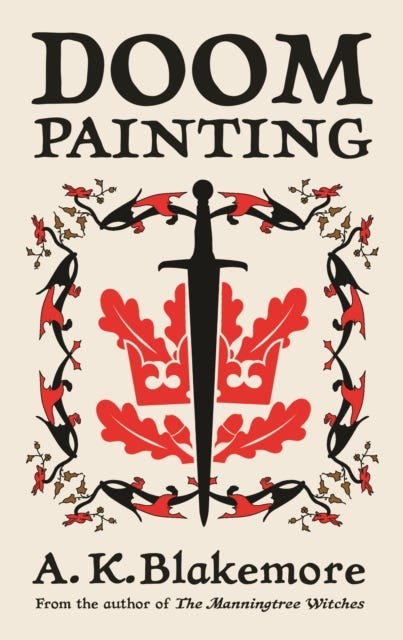
Our reading recommendation this week asks you to take everything you think you know about historical fiction, everything you think you know about authors who write historical fiction, AND everything you think you know about the medieval period, and chuck it all out of the window.
Doom Painting by A. K. Blakemore – one of the most original, inventive, exciting and frankly cool authors of historical fiction around – is both a gorgeously rich and vividly brutal depiction of the Peasants’ Revolt of 1381. If you’ve been to the cinema recently, you’ve probably seen a trailer for The Uprising – the latest film from Paul Greengrass, starring Andrew Garfield, which covers the same events. I’ll admit, I’ve not seen the film, but I am willing to wager that £20 and several hours spent on Blakemore’s incredible book (fair warning: it is 672 pages!) is a much better use of your time and money.
In case you are not completely clued up on the Peasants’ Revolt, here’s a very quick summary. The revolt began in the spring of 1381 in Essex, when people – struggling with rising food costs, fed up with round after round of increased taxation, and worn down by grief and loss from recurrent plague following the Black Death and a succession of wars in France – refused to pay a new poll tax.
Over the following weeks, resistance grew and spread, culminating in thousands of rebels descending on London. Buildings were destroyed, records of debts and taxes burned, the Tower of London stormed, and key members of the political elite, considered responsible for injustices against “the true Commons”, were killed. Attempting to halt this crisis, the teenage king Richard II met with the rebel leader Wat Tyler at Smithfield. Tyler was stabbed, arrested, and later executed. The remaining rebels dispersed and the revolt was more or less over.
The events of 1381 happened against the backdrop of a society unsettled and destabilised by a pandemic, and marked by an increasing imbalance of wealth and opportunity. A small minority was getting richer and richer, while most were struggling more and more. Add in our social media dominated times and the fact that the revolt was known as ‘The Great Rumour’, you can perhaps see why these events, not often the subject of popular culture, might have resonance today and are suddenly in front of us in not just one but two forms.
Part of the richness of Blakemore’s novel comes from the structure – an hour by hour account from noon on 30 May 1381 to 9pm on 15 June and Wat Tyler’s death – which gives a real sense of the unfolding of the rebellion, of how word travels from place to place, and how more people become emboldened and compelled to translate their dissatisfaction into action.
But the deep luxury in the book comes from her writing and language, and it is the relish, joy and wit with which Blakemore turns phrases, describes, and explores that put her work a cut above. Combining beauty and poeticism with medieval vernacular, peppered with Middle English and medieval French, and a healthy injection of bawdy humour of which Chaucer would have been proud, the prose is the brightest star in a constellation of insight and imagination.
Yet the book is also informative and deeply affecting. The imagery invoked by the book’s title Doom Painting was common in churches of the time and known to almost everyone, intended to leave a lasting impression of the visceral horrors of the Last Judgement. Blakemore’s Wat Tyler is a mercenary, brutalised by wars in which he had little choice to fight, having been left without parents and without a trade by which to live. The rebels he leads (accidentally, unwillingly, but ultimately brilliantly) have seen and lived with death by war, by plague, by poverty over decades. For them, the end is not an abstract horror to come; it is here and it is glorious.
I challenge you to find a better bit of new historical fiction than this. Doom Painting shows all the beauty and brutality that makes us human, and reminds us that people in the past were still people, just like us. Think you’re not interested in the fourteenth century? Think again.
Get your copy of the book here.

Culture isn’t just something to watch from the sidelines. Get Stuck In is our new way of highlighting opportunities to get involved – from workshops and courses to clubs, classes and one-off events where you can learn something, make something or simply have a go.
This week: Late Nights at The Bowes Museum
Fancy trying your hand at painting, making something to take home, exploring the stars or dancing in a museum after dark?
Bowes Lates returns to The Bowes Museum on November 21 with an evening packed with opportunities to get creative, have a go at something new and see the collections from a different perspective.
You can make your own hanging decoration using origami and lace, inspired by the museum’s Lace & Legacy exhibition, or pick up a sketchbook and follow drawing prompts around the galleries in the footsteps of Norman Cornish.
If you’d like to spend longer at the easel, artist Anna Selway’s Framing the Landscape workshop offers a chance to experiment with colour, light and expressive brushstrokes.


Alternatively, Brush & Bubbles combines painting portraits inspired by the museum’s collection with a grazing board and a glass of fizz.
There’s plenty to explore beyond the art workshops, too. Step inside the Wonder Dome planetarium, join a tour of the night sky, discover five favourite objects chosen by the museum’s director or take a rare look inside the vaults and Conservation Studio.
You can also catch the Silver Swan automaton in action, enjoy spoken-word performances from Lizzie Lovejoy and get moving at the silent disco.
General admission is £15, with many activities included. Entry is free for members, under-18s, full-time students and carers. More information at thebowesmuseum.org.uk.
Got something for Get Stuck In?
We’re looking for more ways our readers can get involved in culture across the North East. If you run workshops, courses, classes, clubs or one-off activities – or you’ve signed up for something you think other people should know about – we’d love to hear from you. Get in touch and tell us what we should be getting stuck into.