

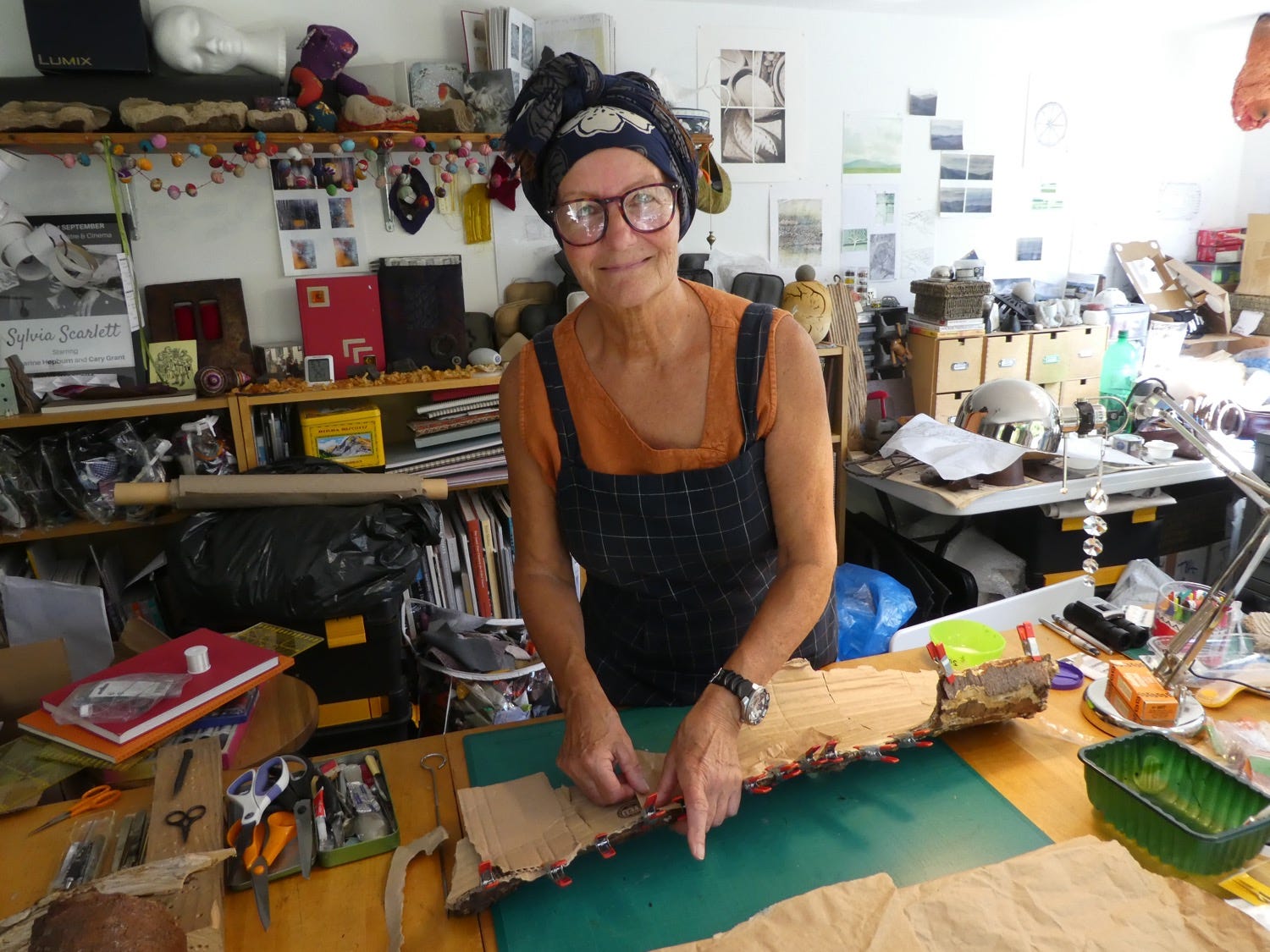
Waste not want not is the watchword for artist Claire Ward.
She certainly does not want for materials as much of the everyday waste from Claire’s household takes on a second life as it becomes part of her sculptures, installations and artworks.
The wide variety of waste items combines with objects natural and man-made which Claire comes across on the coastline and in the countryside near her home outside Wooler in Northumberland.
Now in her first solo exhibition, titled Intimately Connected, Claire is displaying more than 40 of her creations at the Bailiffgate Museum & Gallery in Alnwick until February 28.
Claire’s works begin with a found object – a tyre, tree branch or fishing net float – to which she adds layers of her household waste.
“Found” objects used in the sculptures and installations in the Alnwick exhibition include a fallen tree branch, cast aluminium engine parts, cast aluminium fishing net float, lobster pot float, pine tree bark shard, silage bale wrap, steel van wheel, section of car tyre tread and tyre wall, plastic water bottles, sea shells, a toaster, and a shoe insole.
To these found objects Claire has added layers of household waste such as supermarket fruit nets, plastic food containers such as yoghurt pots, milk bottles, cream cheese pots, and plastic lids, wrappers from biscuits, sweets, and ice creams, plastic bags from dried fruit, muesli, toilet rolls, and ground coffee, film bags from pre-packed salad and vegetables, fabrics from old clothes and other domestic items like old sheets and tea towels.
Then there is cardboard and packing paper from delivery boxes, plastic mailing bags, bubble wrap, tea lights, pill packets and moulded plastic display packs.
“Re-using material is very important. Knowing that the waste I have used represents a fraction of the output of my one small household may give a perspective on the scale of all that we consume and all that we throw away,” says Claire.
“However, first and foremost this show is a celebration of the beauty to be found all around us if we look closely.”
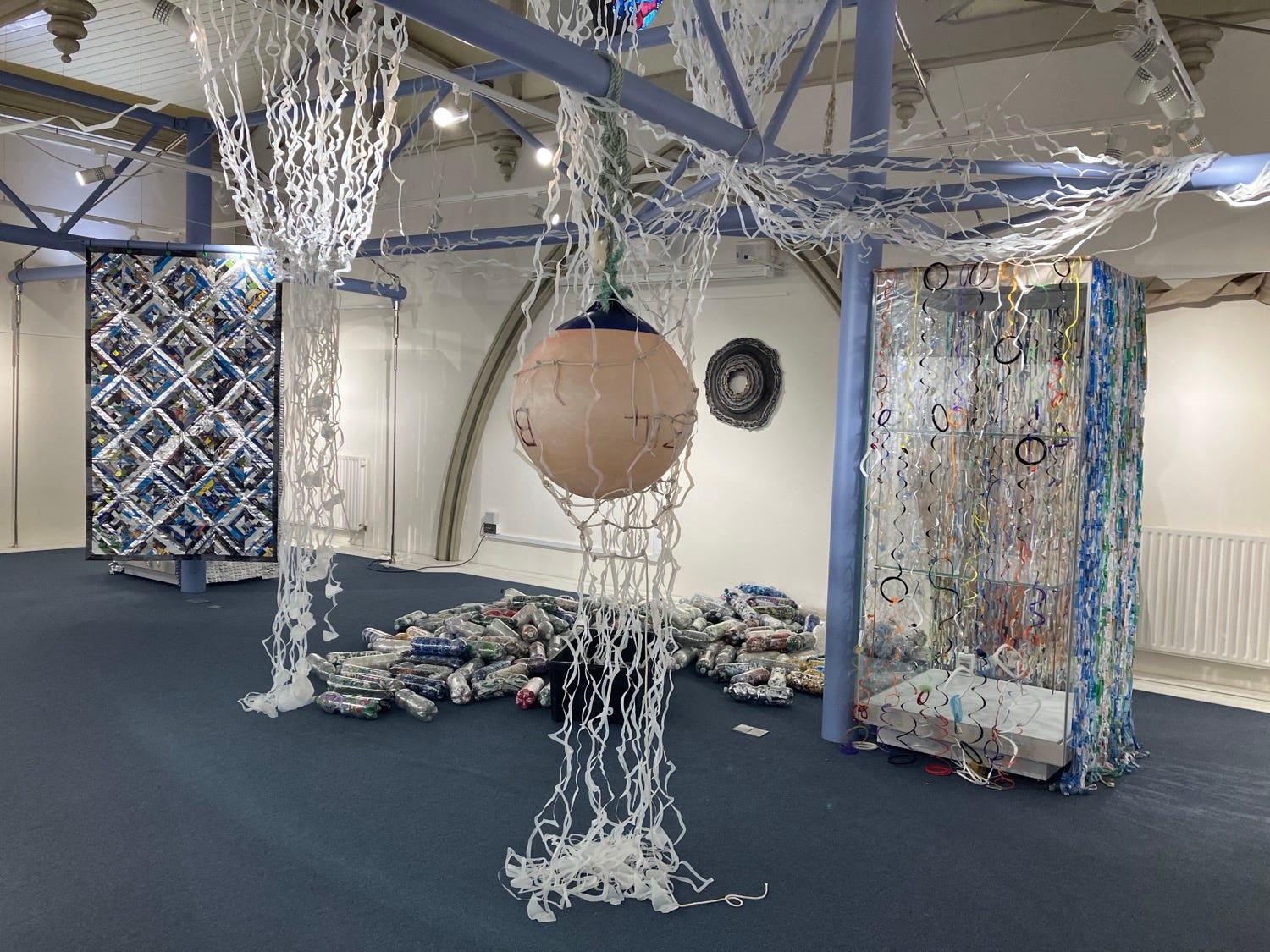
More than 90 plastic milk bottles, each cut into a continuous strip, feature in her exhibit Catch of the Day along with a lobster pot float. The longest strip from a large milk bottle was over eight metres in length and the shortest from the smallest bottles were more than four metres.
A cascade of filled bottles on the floor is titled Bottling it Up and represents four years of Claire cutting up her plastic waste that does not qualify for the recycling bin.
Claire’s Two Blinks of an Eye 1 & 2 is based on two large cabinets draped with aluminium and plastic waste.
From Government statistics Claire worked out that, in volume terms in 2023, household waste was generated at the rate of 2.7 cubic metres per second.
The Royal Society has published a figure that the blink of an eye lasts for approximately one third of a second and so the cabinets each represent what we throw into our wheelie bins in the UK every 0.63 seconds – or in two blinks of an eye.
There are also three cabinets in the exhibition of smaller sculptures and studio pieces by Claire which she is selling in aid of the appeal by the Wildlife Trusts and the Northumberland Wildlife Trust to complete the purchase of the habitat- and wildlife-rich Rothbury Estate Appeal.
“It is a cause I am very keen to support,” says Claire.


For 13 years Claire, a graduate in economics and social anthropology, was a long way from the wild landscapes of the Rothbury Estate as she worked as a BBC film editor in London.
She changed tack to work in a dance company and then went to art college in her 30s. “There was a creative person trying to get out,” she says.
Husband Maurice originally comes from Spennymoor and so the couple would sometimes holiday in Northumberland.
“I instantly fell in love with Northumberland,” she says, and this has been their home for the last 25 years, eight of which has seen Claire work as a full-time artist.
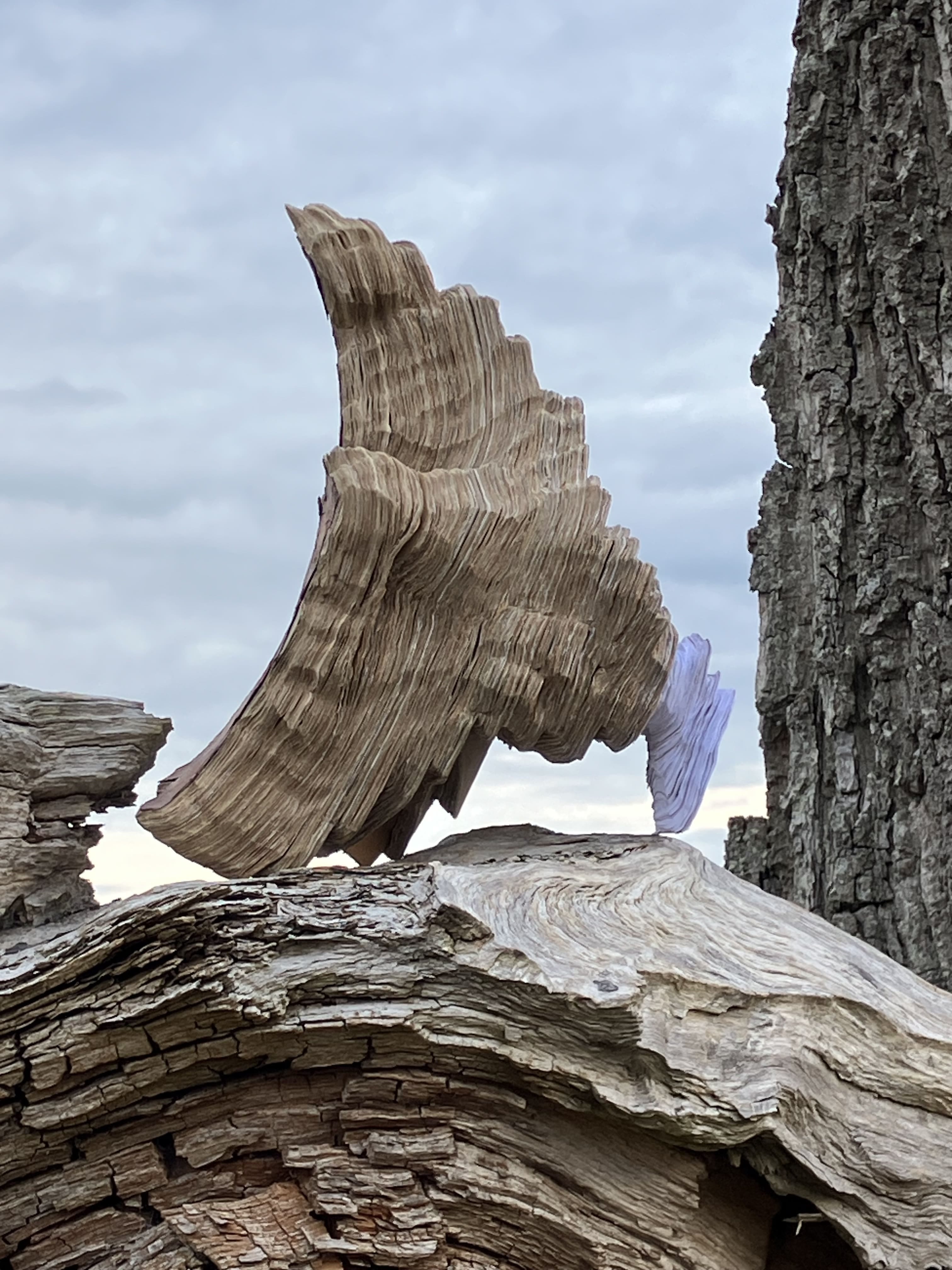
Her projects have included finding a 7ft dead branch whose fissures in the wood reminded Claire of veins. She collected the red netting in which supermarket fruit is sold. Over the course of a year she squeezed the netting into the cracks to represent arteries.
The name of the piece was Intimately Connected and this has lent itself to the title of the whole exhibition as it reflects how Claire works.
“My method of working with my hands and the simplest of tools, scissors and scalpel, enables me to make a direct and intimate connection with the object I’m working on,” she says.
“Most of the work I have made since is made in a similar way so it seemed appropriate to name the entire exhibition after this, for me, very important piece.”
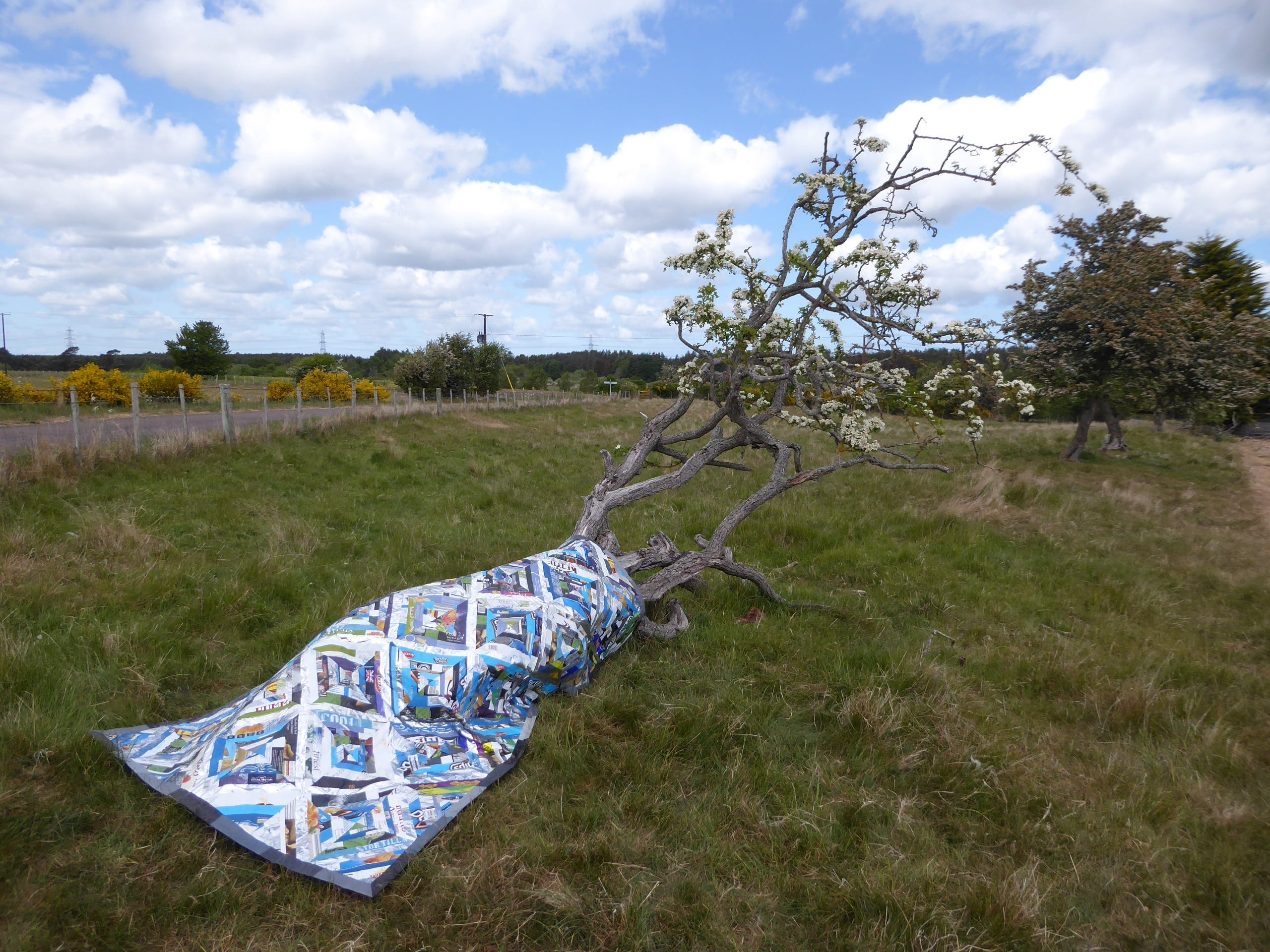
Another of her works focused on a small tree which had been forced into an almost horizontal position but was still alive.
Claire says: “It looked very human and I felt that needed some comfort.”
That led to her creation called Comforter, in which she used quilting techniques to fashion a covering for the tree made from crisp packets, aluminium foil and bubble wrap.
One of her most exotically named pieces arose from her coming across a fence line and trees festooned in weathered strips of black silage bale plastic.
Having cleaned up the area from the plastic, Claire used the material to fashion a piece called Witches Knickers – the name commonly used by locals for the black strips.
Jean Humphrys, chair at Bailiffgate, says: “Through her sculptures Claire takes discarded objects and turns them into astonishing works of art. Her understanding of how to meld and form materials into something unique, fascinating and totally captivating is second to none. It’s a huge privilege to be able to host Claire’s work at the Bailiffgate Gallery.”