


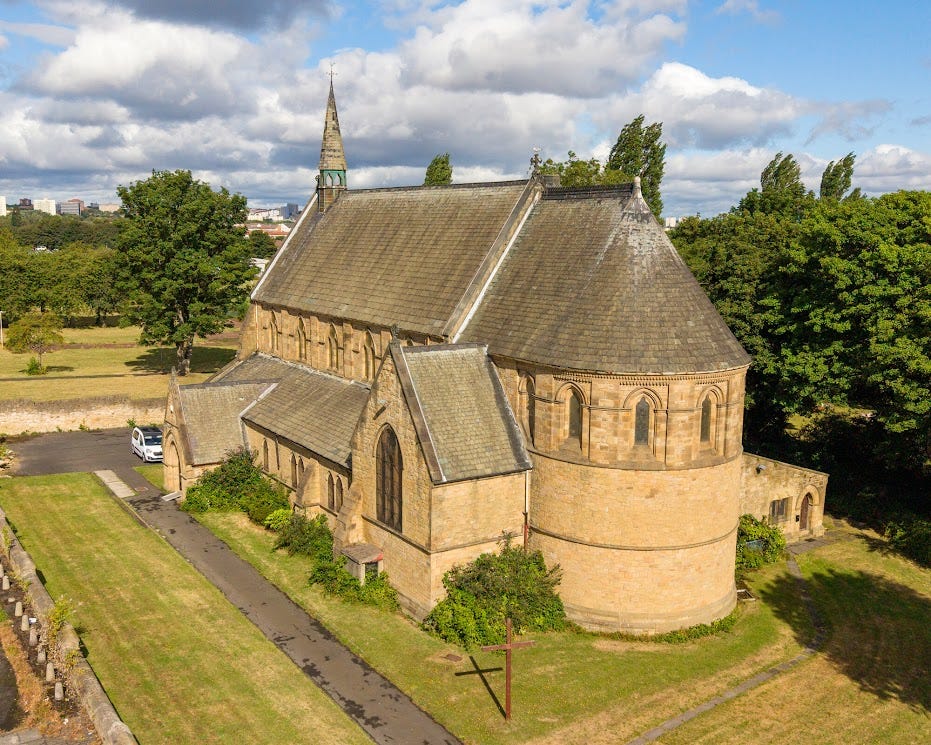
Four churches in the North East have been added to Historic England’s At Risk Register.
Christ Church in Carlisle Street in Felling, dating from 1866, is a vital hub of the local community, operating a food bank and activities such as school holiday sessions for children, but the desire to do more for the area is restricted by the building’s deteriorating condition.
The church has been successful in securing some funding for CCTV and previous repairs, but the poor condition of roof abutments due to lead theft, as well as attempts to steal lead substitute materials, has caused damage to the building’s roof and allowed water to enter.
Another church added to the register is St Augustin’s in Washington Terrace in North Shields. The listed church was consecrated by the Bishop of Newcastle in September 1884.
Two more churches added to the register are St Edmund’s in Edmondbyers in County Durham and St Mary’s in Blanchland in Northumberland.
Also added to the risk list are the 1826 Northumberland Hall in Alnwick’s Market Place and Featherstone Castle in the South Tyne Valley.
Another addition to the register is the Londonderry Institute in Tempest Road in Seaham in County Durham.

Designed by Thomas Oliver and opened in 1855, it was constructed as a literary and scientific institute.
The Grade II* listed Greek Revival-style building served as a focal point and social hub for the community as it expanded thanks to mining during the 19th century under the Londonderry family.
Over the years, the building’s interior has been heavily altered and it has fallen into a state of disrepair. There are plans to renovate it and turn it back into a grand hall with a heritage and museum aspect, featuring historical items alongside digital content showing the history of the town with emphasis on its mining past.
The project also proposes featuring the town’s links to the Londonderry family, Lord Byron and his daughter Ada Lovelace.
The only legitimate child of poet Lord Byron and reformer Anne Isabella Milbanke, Ada was an English mathematician and writer chiefly known for work on Charles Babbage’s proposed mechanical general-purpose computer, the analytical engine.
She was the first to recognise the machine had applications beyond pure calculation and is often considered the first computer programmer.
Claudia Kenyatta and Emma Squire, co-chief executive officers of Historic England, said: “Our historic buildings and places help tell the story of where we live and contribute to the character and identity of local communities.
“The most effective way to protect our buildings is to bring them back into use as places that create connection and enjoyment for local people.”
