

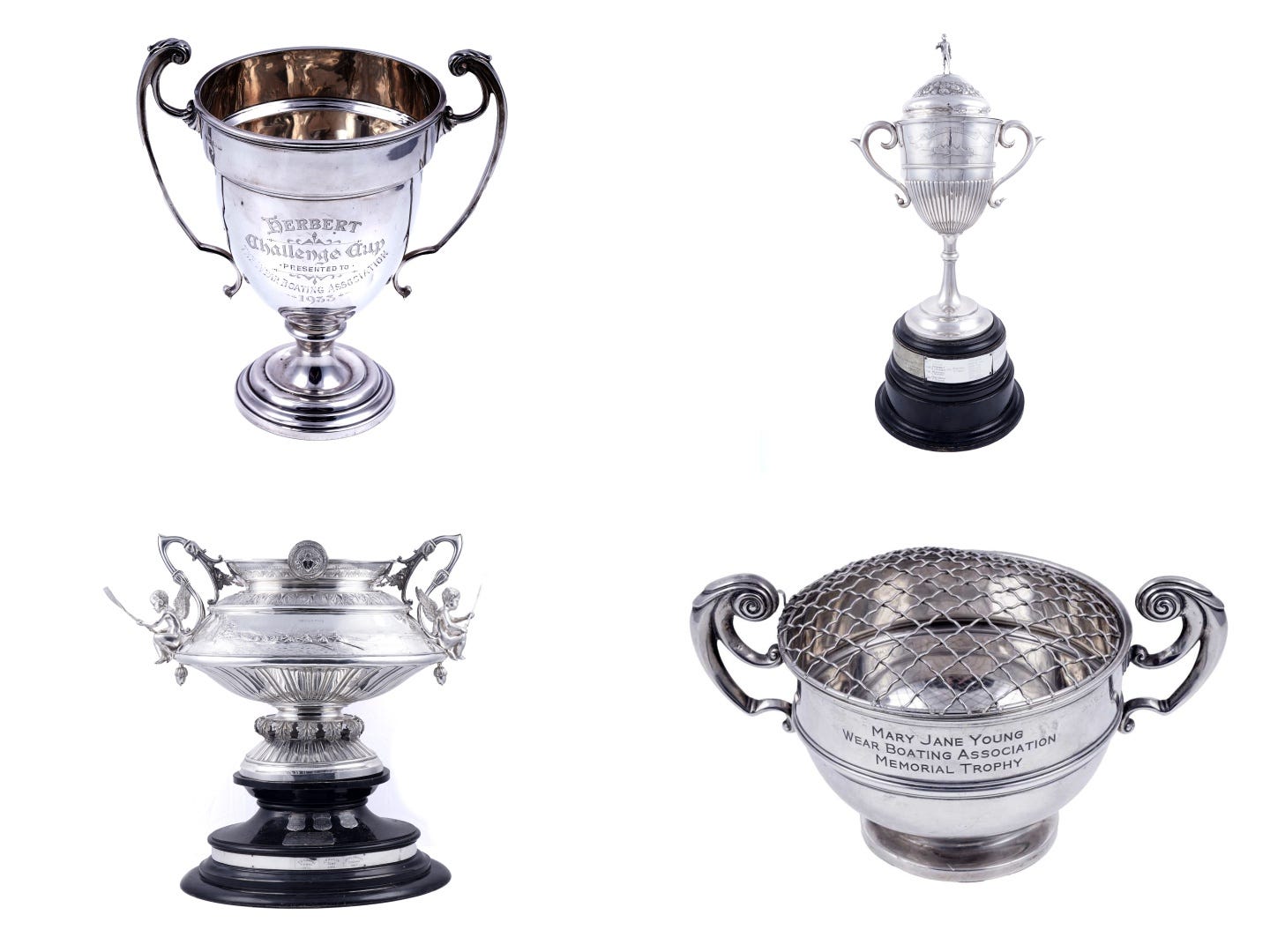
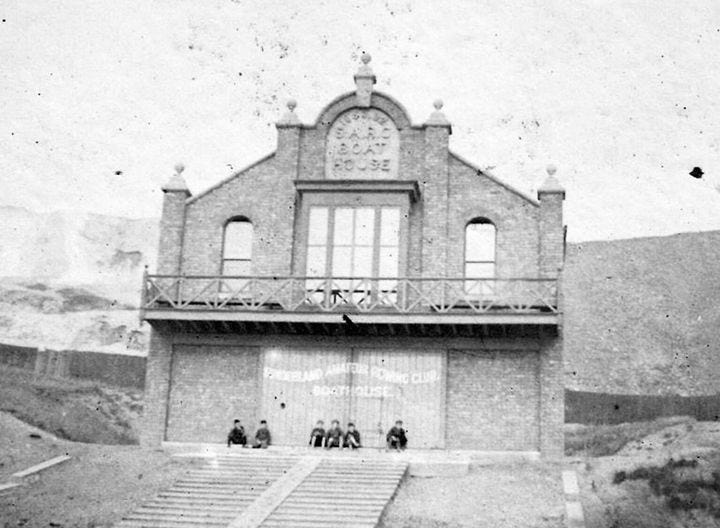
Thirteen silver trophies which recall the history of boating competitions on the River Wear have sold for a total of more than £25,000.
The prizes at the Anderson & Garland sale in Newcastle covered rowing, yacht and motor boat racing, and regattas which were hugely popular annual events.
The top price of £15,600 was paid for a large 1889 silver trophy cup presented by the River Wear Commissioners to Sunderland Amateur Rowing Club.
In 1926 the cup, decorated with views of the Wearmouth Bridge and a rowing match, was competed for by yachts in the Roker Regatta and Carnival. The winner was Mr Brown in the yacht Bonita.
Other trophies sold include a late Victorian silver trophy cup decorated with an engraving of a rowing boat and inscribed with ‘Harry Richardson Victor Ludorum’ fetched £1,950, and a George V silver trophy cup, inscribed ‘Presented by A. E. Welford Ward to the Wear Boating Association (WBA) for annual competition by sailing yachts’, went for £1,235.
An item linked to a celebrated Wearside hero also featured in the sale, which realised a total of £380,000.
A silver snuff box believed to have been made for Admiral Adam Duncan, the victor of the Battle of Camperdown, made £2,340 including fees. The box has a crest, motto and the initials “AD”.
Duncan, who was 6ft 4ins tall, finished his long career as Commander-in-Chief, North Sea (1795-1801).
He played a crucial role in protecting Britain by defeating the Dutch fleet, which was aligned with Revolutionary France, at the Battle of Camperdown off the coast of North Holland in October 1797.
The North Tyneside village of Camperdown is named after the battle, in which 11 Dutch warships were captured.
During the battle the mast of Duncan’s flagship Venerable was felled, which included the admiral’s flag. The lowering of an Admiral’s personal flag was a sign of surrender.
Despite intense gunfire, crewman Jack Crawford from Sunderland climbed the mast to nail back the colours, which is thought to be the origin of the saying “nailing your colours to the mast.”
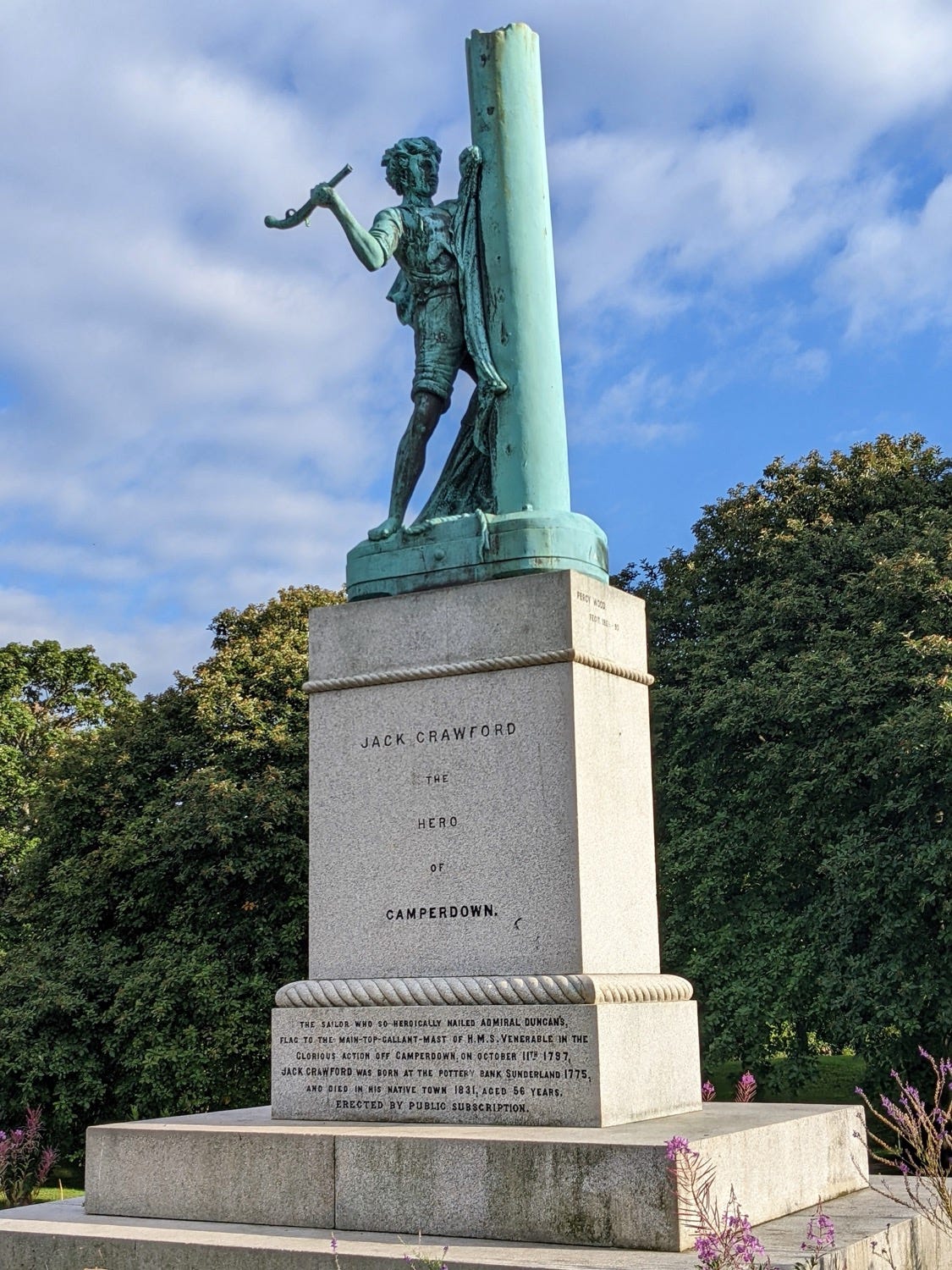
Crawford was born in Pottery Bank in the East End of Sunderland. He was a keelman until 1786 when he joined the crew of the Peggy at South Shields.
He joined the Royal Navy in 1796, possibly as a result of being press-ganged, but he may have volunteered, and served on HMS Venerable.
After the victory procession in London he was presented to the King and was given a government pension of £30 a year, and later a silver medal from the people of Sunderland.
Crawford fell on hard times and had to sell his medal. At the age of 56 he became the second victim of the cholera epidemic of 1831 and was buried in an unmarked grave.
Towards the end of the 19th century interest in the ‘Hero of Camperdown’ was renewed, in part through the success of a play by Sunderland playwright James Roland MacLaren, which went on tour from 1879.
This resulted in the erection of a headstone in Holy Trinity, Sunderland churchyard in 1888. Two years later public donations led to a monument being erected in Mowbray Park.