

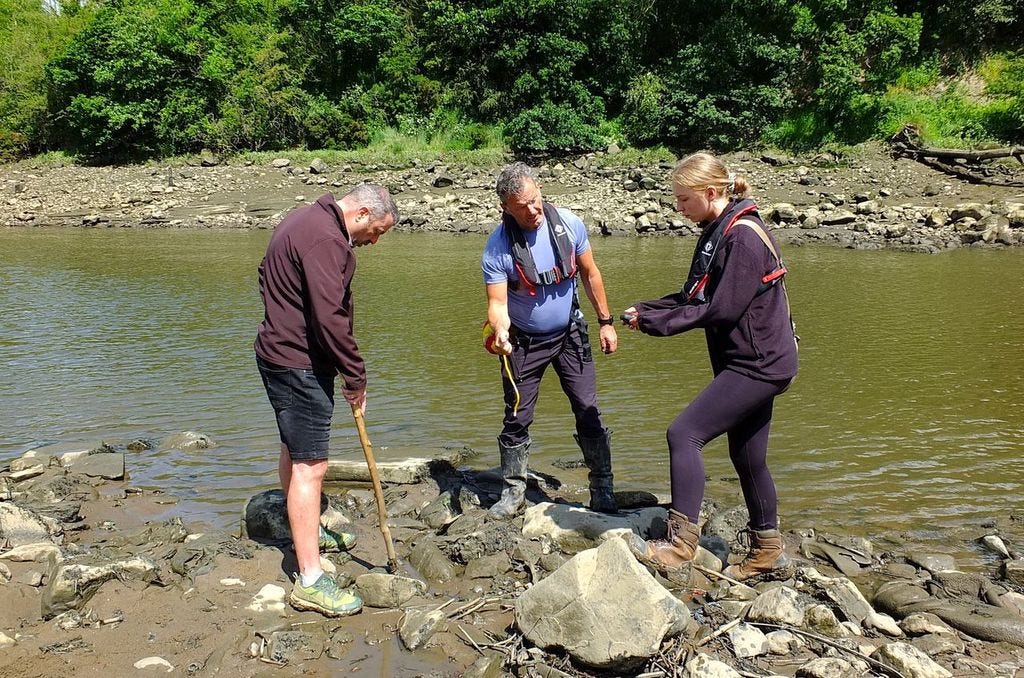
Community diggers have discovered evidence of a Roman industrial hub on the banks of the River Wear.
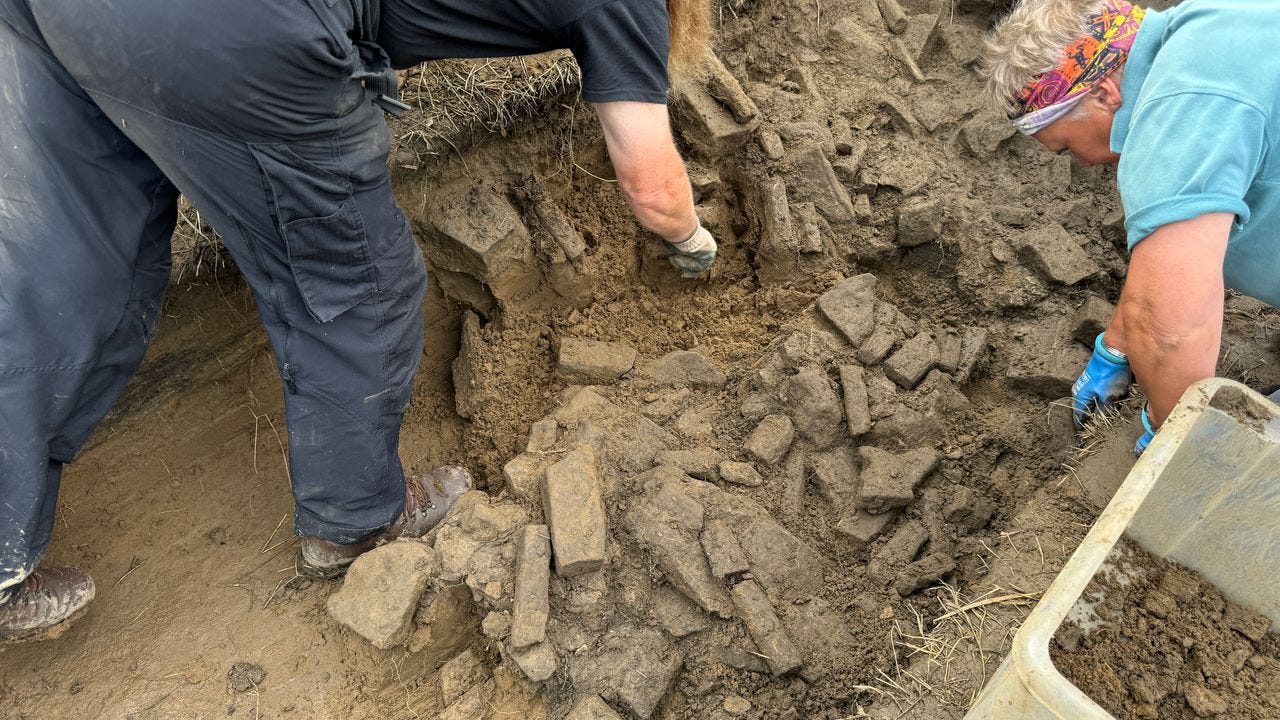
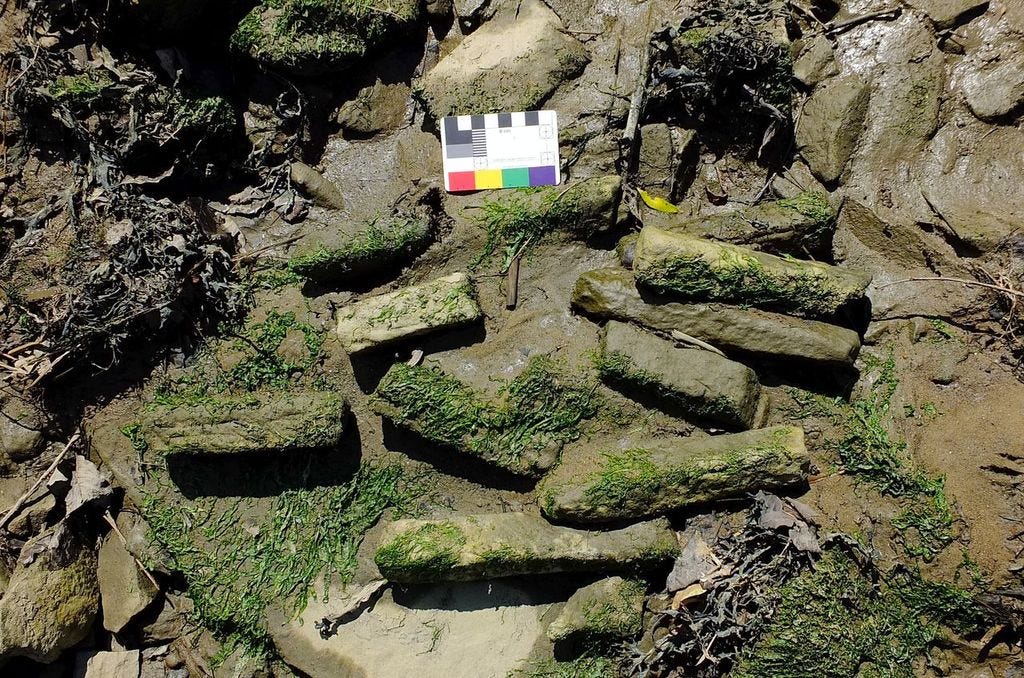
The Offerton site, on the edge of Sunderland, has so far yielded more than 800 whetstones – stone bars used to sharpen bladed tools and weapons – and 11 stone anchors.
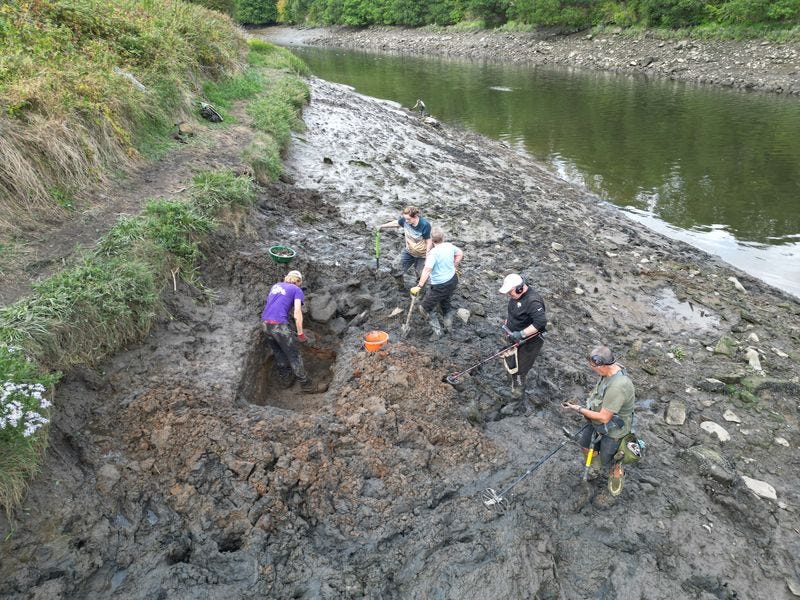
The site was found and excavated by volunteer enthusiasts from the Vedra Hylton Community Association and supported by Durham University’s Department of Archaeology.
Association president and TV archaeologist Gary Bankhead, who led the dig, said: “Here, we see compelling evidence of one of Sunderland’s earliest known industries.”
The excavations will be featured on the new series of Digging for Britain on BBC Two and available on iPlayer from today, Wednesday January 7. Episode 4 is the one to watch.
The find represents the largest known whetstone discovery of the period in North West Europe, and places the North East firmly within Roman Britain’s sophisticated manufacturing and trade network.
Whetstones, used to sharpen blades, were vital tools in every aspect of Roman life – from the domestic and commercial to the agricultural, industrial, medical and military.
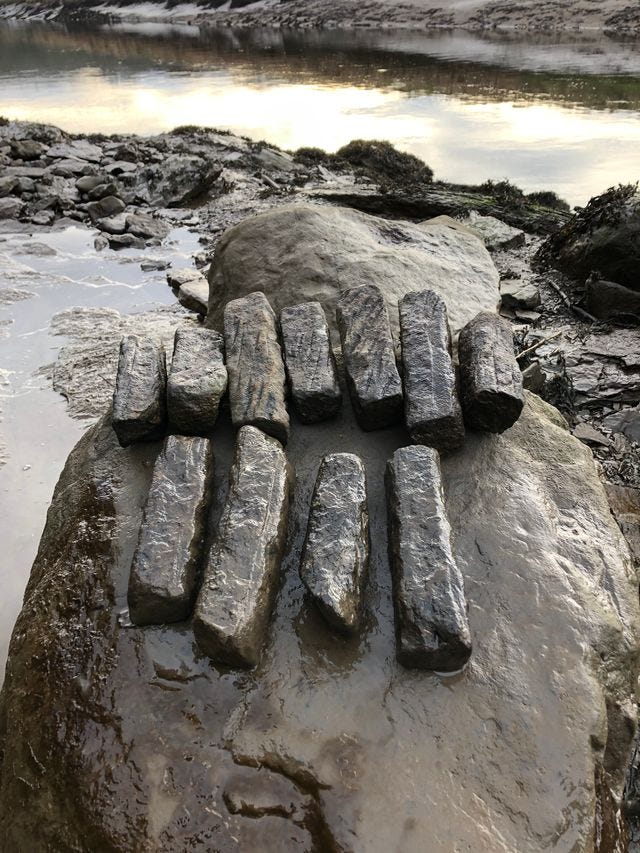
The abundance and condition of the whetstones discovered, along with a corresponding sandstone outcrop on the opposite side of the river, indicate Offerton was likely a major production hub in Roman Britain.
The site has been dated using Optically Stimulated Luminescence (OSL) testing on the sediment layers surrounding the whetstones.
OSL measures when minerals such as quartz were last exposed to sunlight. Over time, these minerals build up a tiny store of energy while buried. When stimulated with light or heat in the laboratory, the minerals release this energy as a faint glow, which tells experts how long they have been underground.
The results showed that sediment samples taken directly below the whetstone discovery were dated to 42–184AD, whilst the sediment sample taken from the whetstone layer was dated to 104–238AD – during the Roman period in Britain.
The results suggest Offerton is the first Roman site found in Britain where stone was deliberately quarried for whetstone production.
Alongside the 800 whetstones, the team believe that there are hundreds, possibly thousands, more that remain buried within the riverbank.
Gary Bankhead, from Pity Me in County Durham, and Honorary Fellow of Durham University’s Department of Archaeology, has spent 16 years diving in the Wear to retrieve 14,500 objects from the riverbed and has just written a book on the pilgrim and related religious items among the finds.
The huge range of objects from the vicinity of the historic Elvet and Prebends bridges give a glimpse into the everyday lives of residents and pilgrims in Durham across 700 years.
The Offerton dig has been supported by staff and students from Durham University’s Department of Archaeology, including Bronze Age and Roman experts Dr Benjamin Roberts and Dr Eleri Cousins. The OSL dating was led by Dr Eric Andrieux.
The project team also undertook excavation works along the riverbanks and foreshore at Offerton, with support from The Crown Estate.
“This isn’t just a Roman site – it’s Sunderland’s story, revealed through the dedication of local volunteers and researchers working side by side. The River Wear has once again offered us a remarkable discovery, and we are only beginning to understand its full legacy.”
Gary Bankhead
The Crown Estate manages around half the foreshore around England, Wales and Northern Ireland, including some estuary and tidal riverbeds, and the seabed out to 12 nautical miles.
Over the course of six months in 2025, the team found the vast haul of whetstones in various stages of production, from roughly worked pieces still bearing tool marks to finely finished examples with smooth surfaces and chamfered edges.
The team also found 65 ‘doubles’ – whetstones still conjoined prior to splitting – along with a rare ‘treble’.
The recorded whetstones are all damaged and were likely discarded during production as they no longer met the required length. The Roman army were particular about the uniformity of their equipment, so any whetstones that were not exactly 12 inches would have been discarded.
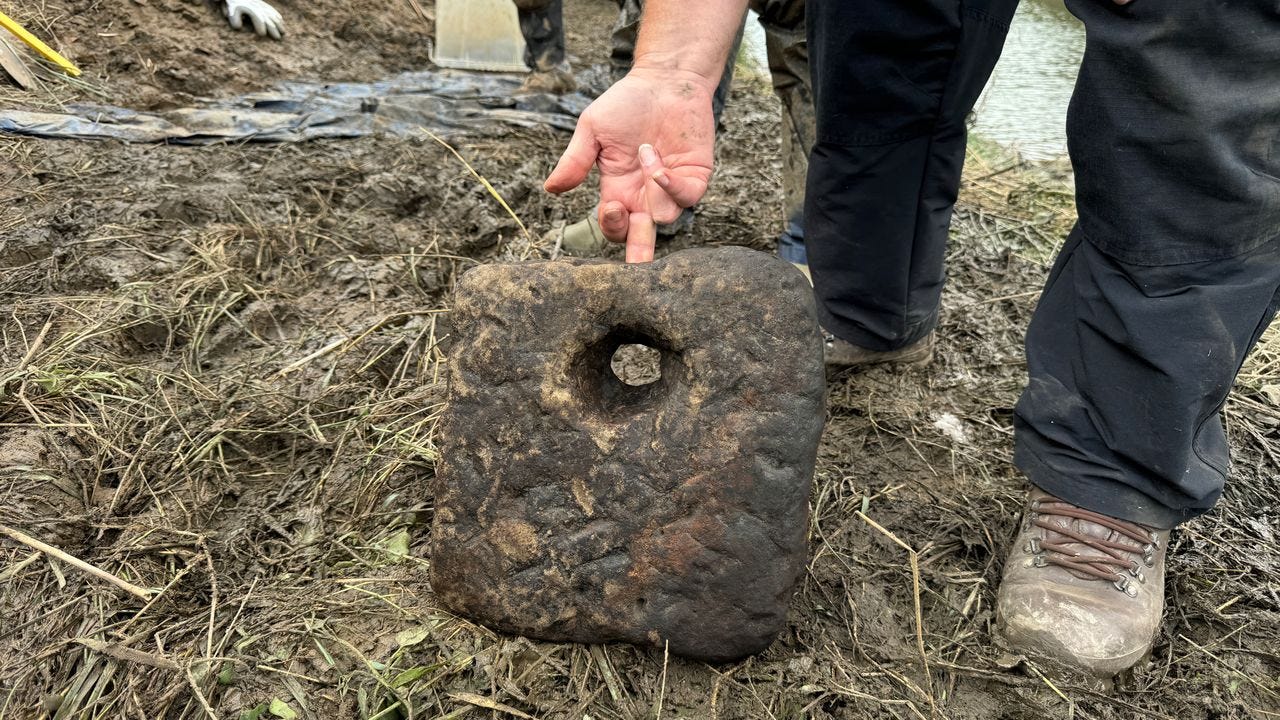
Five stone anchors were also unearthed by the fieldwork team. Six stone anchors had been recovered in the adjacent stretch of river in 2022. This brings the total to 11 – the largest number of stone anchors ever found at any northern European river site to date.
The team believe the anchors could have been used by river-going vessels that were transporting slabs of sandstone across the river for whetstone preparation.
As well as whetstones and stone anchors, the team also discovered:
A post-medieval wooden jetty structure, and earlier stone-built jetty.
Tools including chisels and stone splitters.
A leather shoe from Tudor times.
Iron and stone cannonballs, and lead shot dating to the English Civil Wars.
While a clash at Offerton was already known, discoveries of ammunition extend the mapped area of conflict and suggest the riverside site held greater strategic importance than previously understood.
The wooden jetty and associated small finds may relate to the women known as “hailers,” who once hauled keel boats upriver. Skippers would literally “hail” for their help as vessels headed upstream to collect coal, often struggling against the tide and wind.
With ropes looped over their heads and sticks for leverage, the hailers towed the boats toward the staithes – sometimes several at once. Their labour, rarely recorded in written history, was vital to Sunderland’s early river economy, and the Offerton jetty may mark one of the places where this demanding work took place.
Collectively, these discoveries could extend the known timeline of human activity along this part of the River Wear by over 1,800 years.
Further geophysical survey work would be needed to determine the full scale and extent of the site.
Gary Bankhead said: “This isn’t just a Roman site – it’s Sunderland’s story, revealed through the dedication of local volunteers and researchers working side by side. The River Wear has once again offered us a remarkable discovery, and we are only beginning to understand its full legacy.
“At Offerton, the recovery of Roman coins, along with firm OSL dating, now confirms the site’s Roman origins. The manufacture of whetstones at this location closely matches examples from securely dated Roman contexts, demonstrating that whetstones were being produced – and very likely distributed – from this riverside workshop.
“It is another extraordinary chapter from a river that continues to rewrite history.”
Dr Eleri Cousins, assistant professor in Roman archaeology at Durham University, said: “With the confirmation that these whetstones are Roman, this site has the potential to make a significant addition to our understanding of manufacturing and industry in Roman Britain, particularly in the militarised north of the province.
“This is an exciting discovery that tells a fascinating story about how ordinary objects like whetstones could be produced on an industrial scale.”
Coun Michael Mordey, leader of Sunderland City Council, said: “Ships, coal, pottery, glass and cars have all been made on the banks of the River Wear over the years by generations of Sunderland families and, thanks to the results of research and analysis carried out by Durham University, this work has revealed yet another generation of makers who have shaped the industrious city we are today.
“This shines a whole new light on the role Sunderland may have played in the Roman Empire, presenting an exciting opportunity to learn new things from our rich historical past. This has been a remarkable effort by all involved and I’m sure I speak for the entire city when I say we can’t wait to find out more about what this research reveals.”
Emily Swift, senior asset manager for coastal at The Crown Estate, said: “We were so excited to hear of a Roman archaeological discovery in the River Wear and it’s been fantastic to work collaboratively with partners to bring this to life.
“Mapping out the historical significance of the River Wear also helps our team to work closely with Sunderland City Council to sensitively maintain and preserve the river and riverbanks for future generations to enjoy.”
There are one or two in Jesmond that they missed. Not abundant but not in bad nick either. Dave W