

Written by artist and friend, Jill Journeaux
Ken Turnell was born in Sheffield in 1948, but his family moved to the North East when he was a young child as his mother had originally come from the area.
He was educated at Jarrow Grammar School in the 1960s and whilst there, attended Saturday art classes at Newcastle University along with artists Jeff Dellow and Ed Ullyart. Ken completed a Foundation Diploma in Art & Design at Hornsey College of Art, then gained a BA in Fine Art at Maidstone College of Art and went to Chelsea as a postgraduate.
As a young artist he had considerable success and exhibited his sculpture in key exhibitions in the late 1970s and early 1980s. These included the 1976 Summer Show 1 at the Serpentine Gallery, London, the 1981 British Sculpture in the Twentieth Century show at The Whitechapel Gallery, London, Questions About Sculpture at Bolton Art Gallery and Museum. The Guardian (of the sculptor) 1976 was acquired by the Arts Council.
Ken was an important figure in the establishment of Grizedale Sculpture Park in Cumbria, contributing several pieces in the early years. His key sculptures at Grizedale included The Eye 1984, Beech Watch, 1978 and Sawrey Bank Watch, 1978. Ken was amongst the first group of sculptors at Grizedale and later returned to work in Grizedale in 1986. He described his experience of working in the forest in the publication A Sense Of Place 1984:
“Having come from a large town to live in Grizedale, I also noticed a sharpening of senses that had dulled. Instead of closing off noise, and any distractive forms as I do in the city, I felt more inquisitive and instead of passing through the city to some destination, I felt no similar need in the forest. The place was complete. Important elements of wind, night, darkness and all changes of weather and their effects in transforming all natural forms was abundant and very potent.”
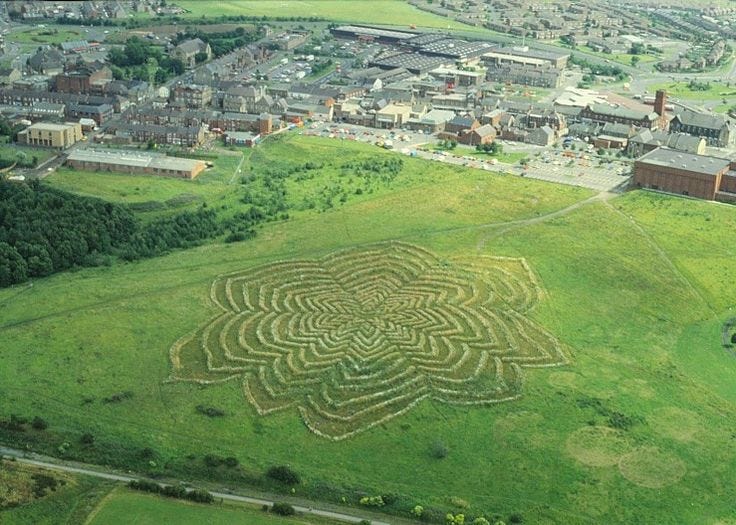
This fascination with nature, place and landscape continued into his work with Sustrans and the Sea to Sea (C2C) cycle lane art trail, and his major earthwork Flower Mine. The shallow mounds and seasonal flowering ox-eye daisies revealed a huge flower drawing that covered the site.
From the mid 1980s onwards drawing became central to Ken’s practice – whether on paper, on land or on the beach. He made an extraordinary series of ink drawings on paper including Light Grows 1984, and I in Light 1985, which revealed his sense of personal place within natural landscapes and a holistic comprehension of his place within the universe. This enquiry into light and illumination resulted in a series of wired mirror sculptures one of which was displayed in Leicester Cathedral.
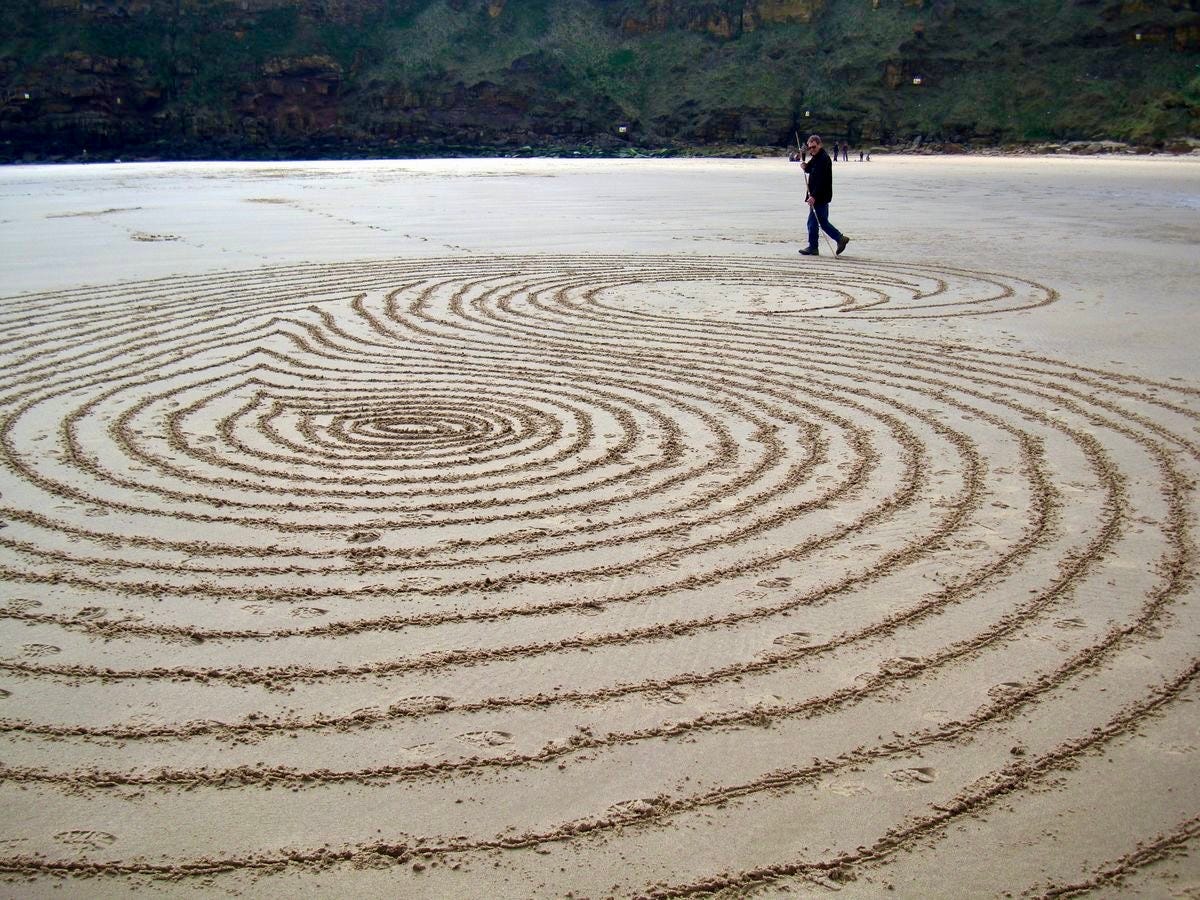
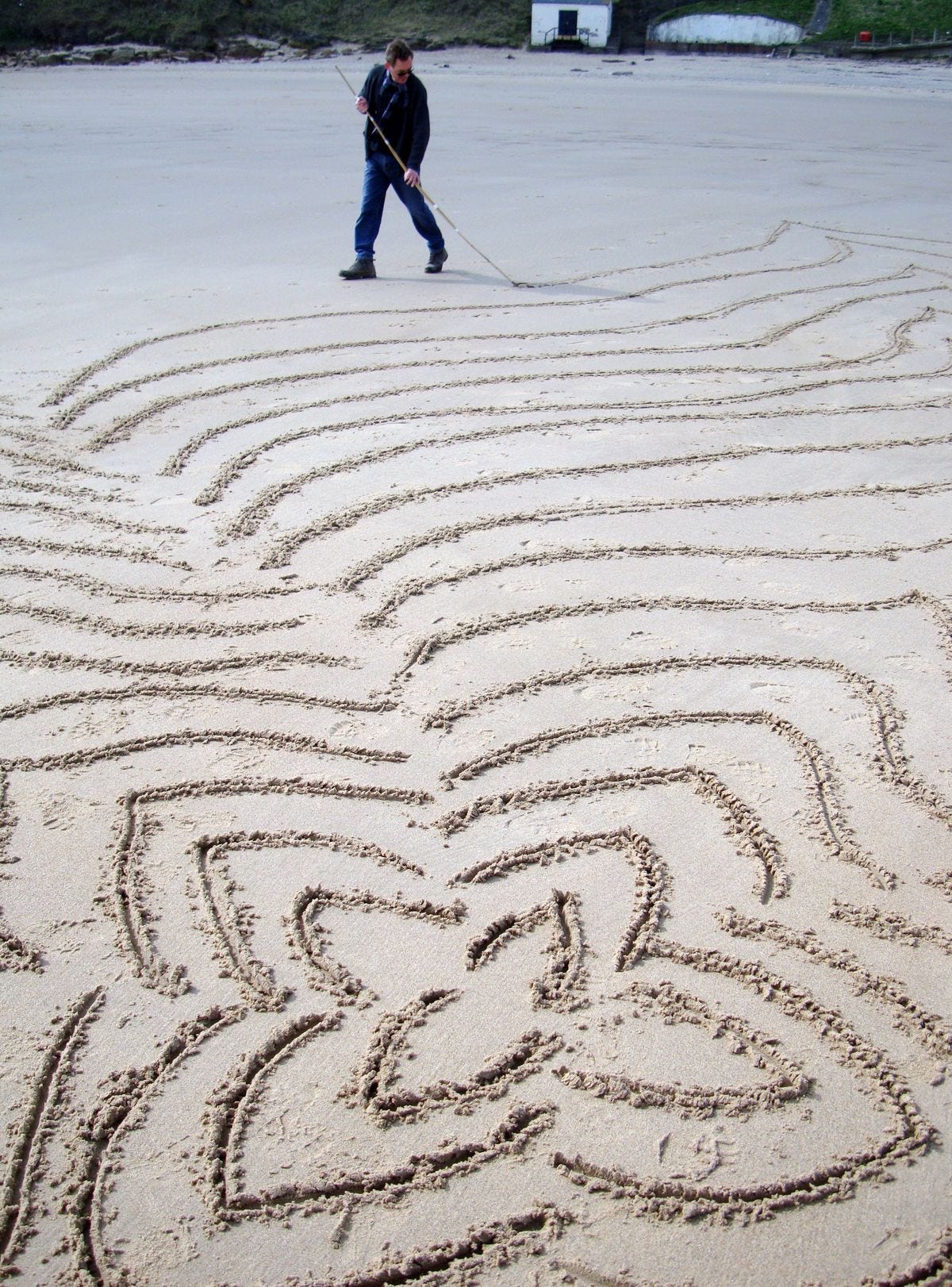
His large-scale sand drawings, made between 2000 and 2016, combined a fluency of drawing, walking and inhabiting a place, with ideas of the temporal; of finding and delineating a drawing only to have it washed away as the tide turned.
These drawings brought together a love of natural material, the beaches at Tynemouth, Cullercoats, and King Edwards Bay in the North East, observation of the natural world and our primaeval need to mark our moment on the earth, even if it is subsequently erased. Photographs and videos of these works featured in the exhibition Between the Lines at The Attenborough Gallery, Leicester.
Ken was a highly regarded and charismatic teacher. He worked at many institutions in the 1980s and 1990s including: Wimbledon College of Art – alongside Glynn Williams, Mike Penny and Lee Grandjean, St Martins School of Art with Tim Scott, Central School of Art & Design with John Panting, Hull School of Art, Nottingham Trent University, Newcastle University and De Montfort University.
He mainly taught drawing and made a notable contribution to the Architecture courses at East London where he worked with Christine Hawley CBE and Zaha Hadid. His students remember him as an energetic, curious and enlightening tutor – always engaged and eager to understand what they were doing.
In 2013 Ken moved to live in rural Southern Portugal where he was fully immersed in nature and the landscape and was able to sit and observe the valley below his home and studio, the spectacular evening sunsets and the clear views of the milky way.
He exhibited at Recriativa 14, Olhão, and at Amigos do Museu in São Brás de Alportel with his partner Karen Livingstone and participated in mixed shows at Artesis Tavira. He also ran a small art class in São Brás up until late 2025.
He is survived by his partner Karen Livingstone and his two children, Tom and Daisy Turnell.