


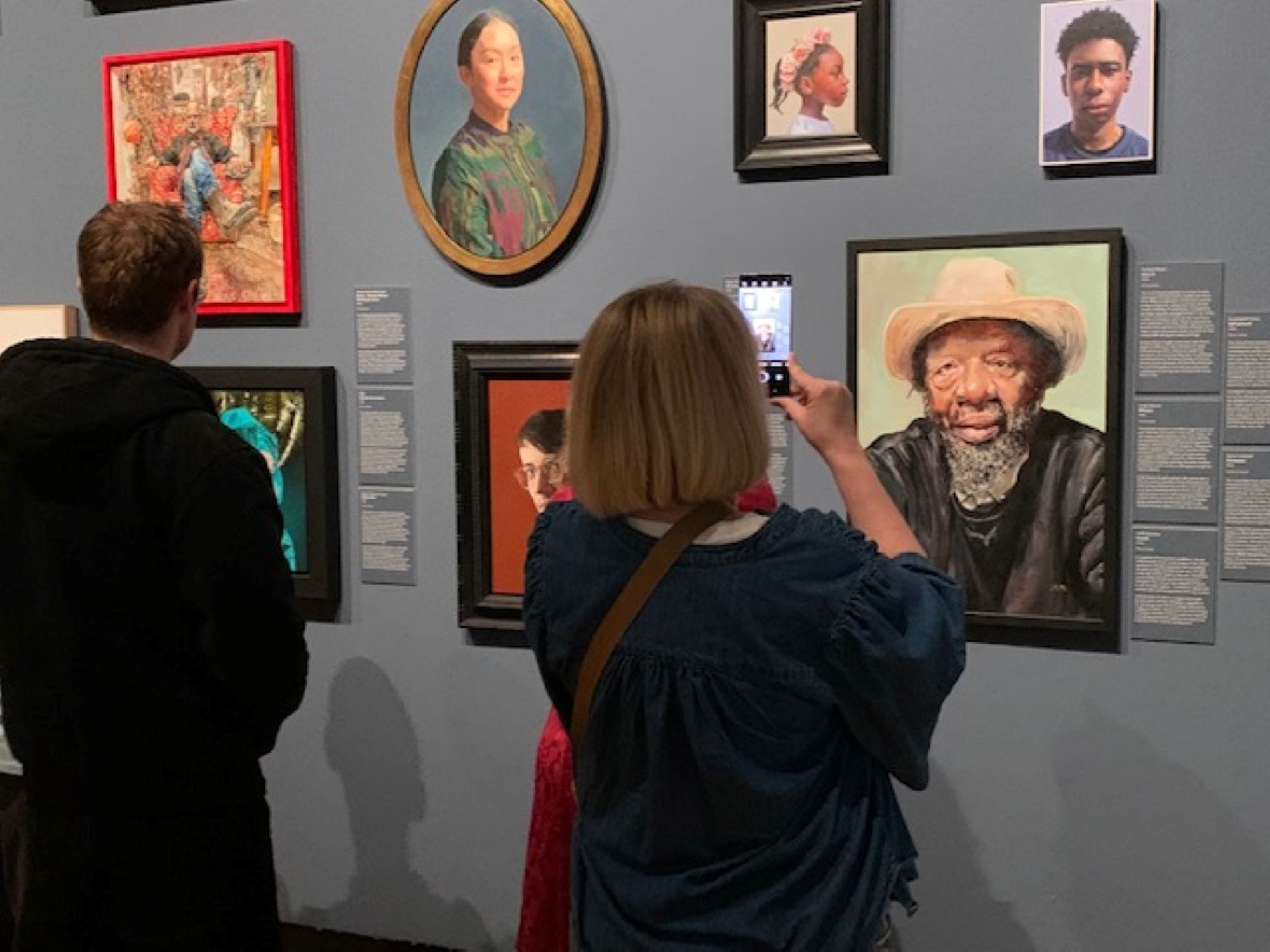
For anyone fond of a bit of people watching, a portrait exhibition is a gift – a chance to stare without arousing suspicion or causing offence.
And there is so much to stare at in the Laing Art Gallery’s latest ticketed attraction, which is actually two related exhibitions in adjoining rooms.
The first room you enter has 27 portraits from the collections of North East Museums, all arranged under the nice, broad title Exploring Identity.
Historical context is the promise and in this regard it does deliver, with paintings in different styles and from different eras, although mostly dating from the 20th Century.
Anyone who has visited the Laing, Hatton or Shipley galleries over the years can expect to see some old favourites.
Hazel in Black and Gold has been fixing us with an imperious eye for many years now, ever since she was given to the Laing in 1916, the year she was consigned to canvas by Sir John Lavery.
Hazel was actually his wife.
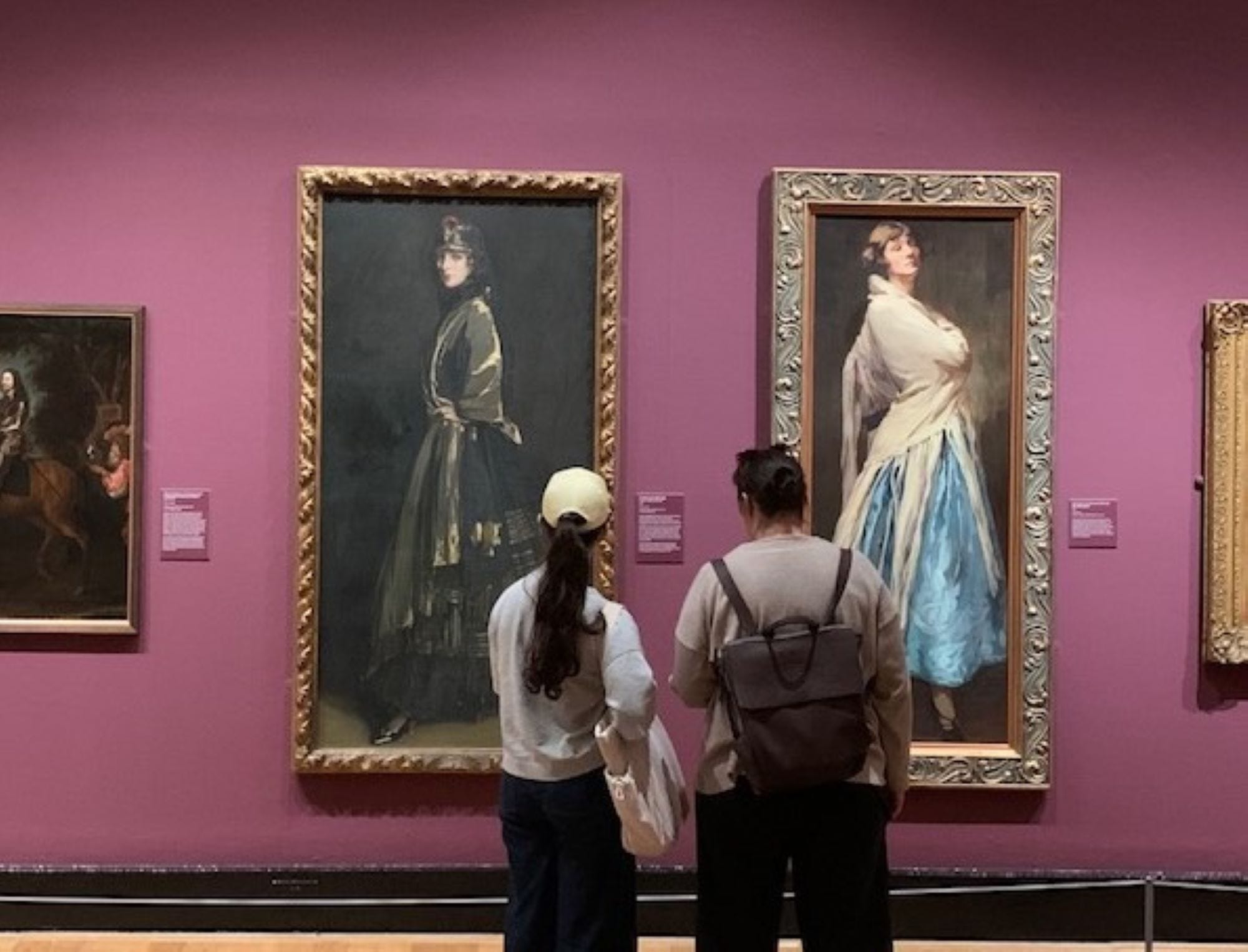
Sir John, we are told, was an official war artist at the time but too ill to travel so instead painted Hazel in a military style hat. What it contributed to the war effort is open to debate but Hazel’s likeness has been stiffening the resolve of gallery-goers ever since.
There are paintings by Francis Bacon and Frank Auerbach, big and little and side by side. Auerbach, who died in 2024, also painted his wife although in a way signalling – so we are told - the changes in her life.
Evidently they were pretty drastic and I wonder if Julia was happy with it in her heart of hearts. She looks like a mummy, of the Egyptian rather than the maternal kind.
The couple were separated for a significant period in the middle of their long marriage but according to their son it was “unorthodox but reasonably functional”.
Everyone is likely to find a surprise or two in room one.
It might be the neat little self-portrait by Harry Thubron, a painting only attributed to him in very recent years after some research.
Thubron, born in County Durham, was an artist mostly remembered for his abstract works and for his teaching.
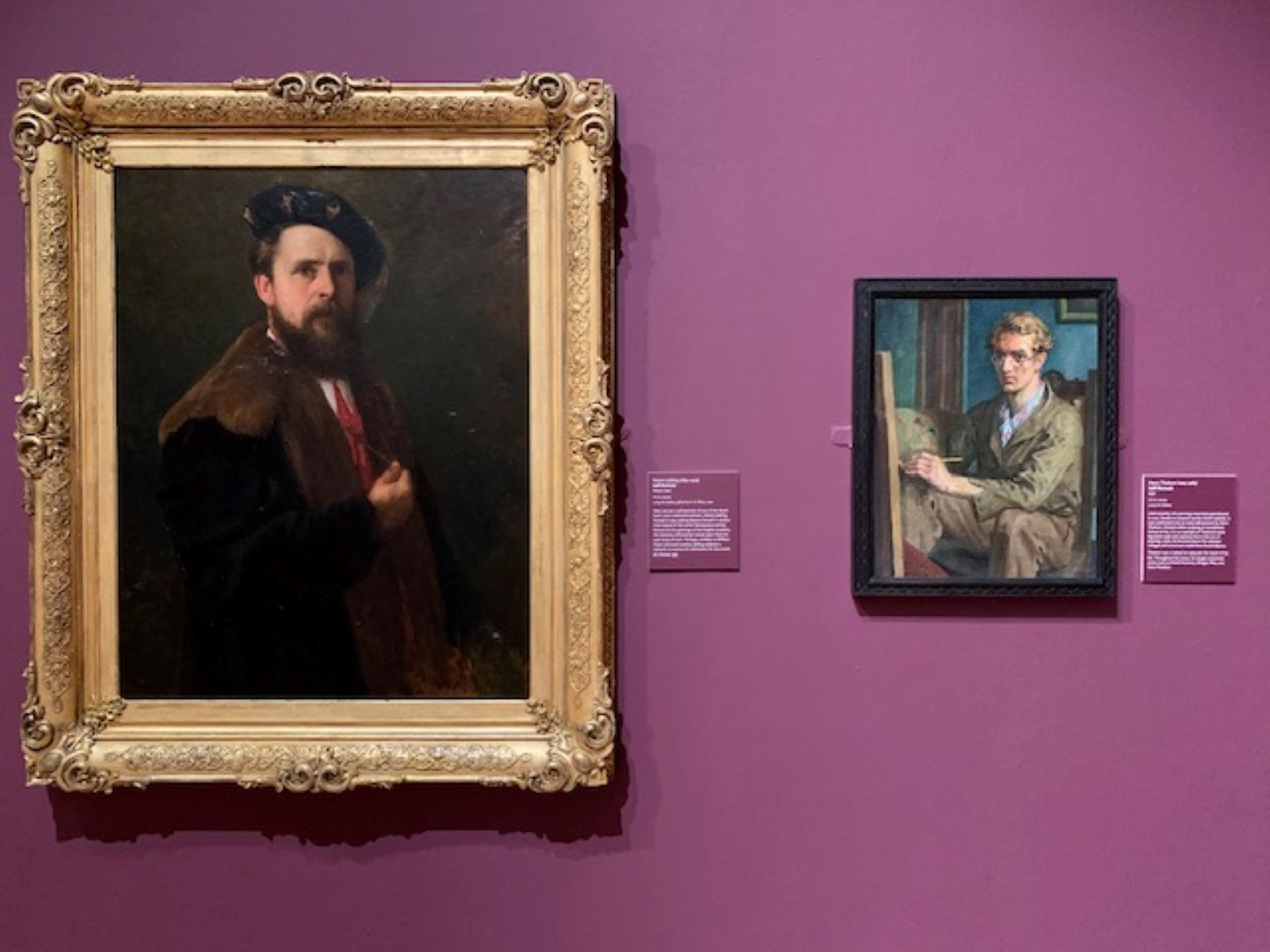
This picture dates from 1937, when he would have been studying at Sunderland School of Art, which is where he returned to teach after serving in the Second World War – and before moving on to take up posts in Leeds and other places.
He was awarded an OBE in 1978 for his contributions to the arts and art education and died in London in 1985.
He’s been positioned here in an artists’ corner between self-portraits of Newcastle-born Robert Jobling and the Irish artist William Orpen who produced paintings from the trenches during the First World War but also liked to depict himself flamboyantly dressed – here aping an 18th Century French artist, Jean-Baptiste-Siméon Chardin, and looking ever so faintly clownish.
Not so much a surprise as a bit of a shock (to me, anyway) is Daniel O’Neill’s The Doll Maker, in which the maker of the title has either made dolls in her own image or has become a doll in a sort of sinister twist.
There are plenty of strong women in this first room, three of them the work of Beryl Fowler (née Menzies) who was born in Newcastle in 1881 and knew how to put a defiant glint in a female eye.
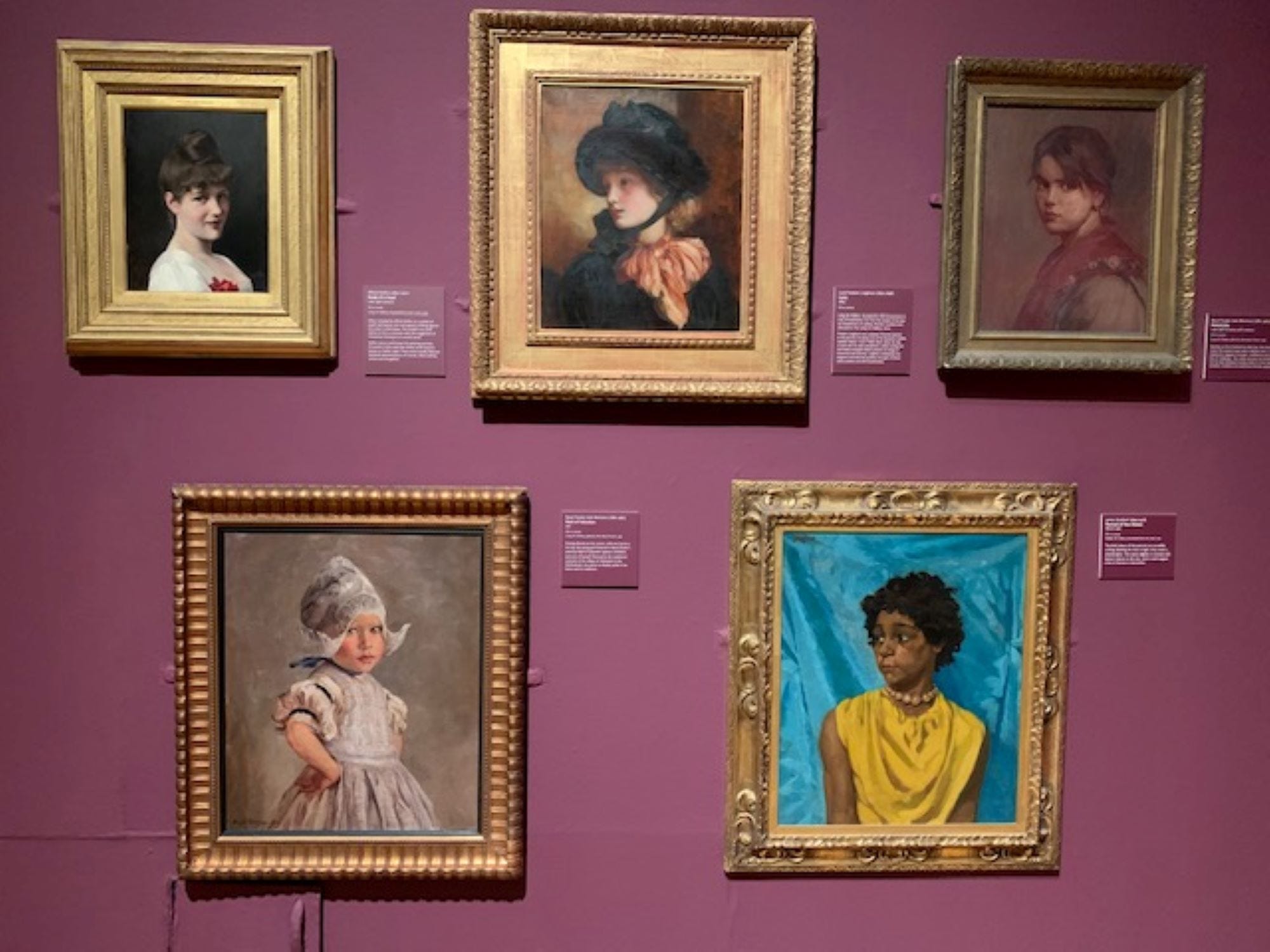
One of her portraits, The White Shawl, 1925, is hung next to Hazel, the fabulous frames adjacent but the female subjects back to back, as if after a tiff.
Here we have paintings gifted, bequeathed, allocated in lieu of inheritance tax and purchased with the aid of grants. Thus are public collections built over time and thus the styles and stories accumulate to beguile us.
But once you’ve done with context, it’s on to the second room devoted to the 43rd annual Herbert Smith Freehills Kramer Portrait Award, 2025.
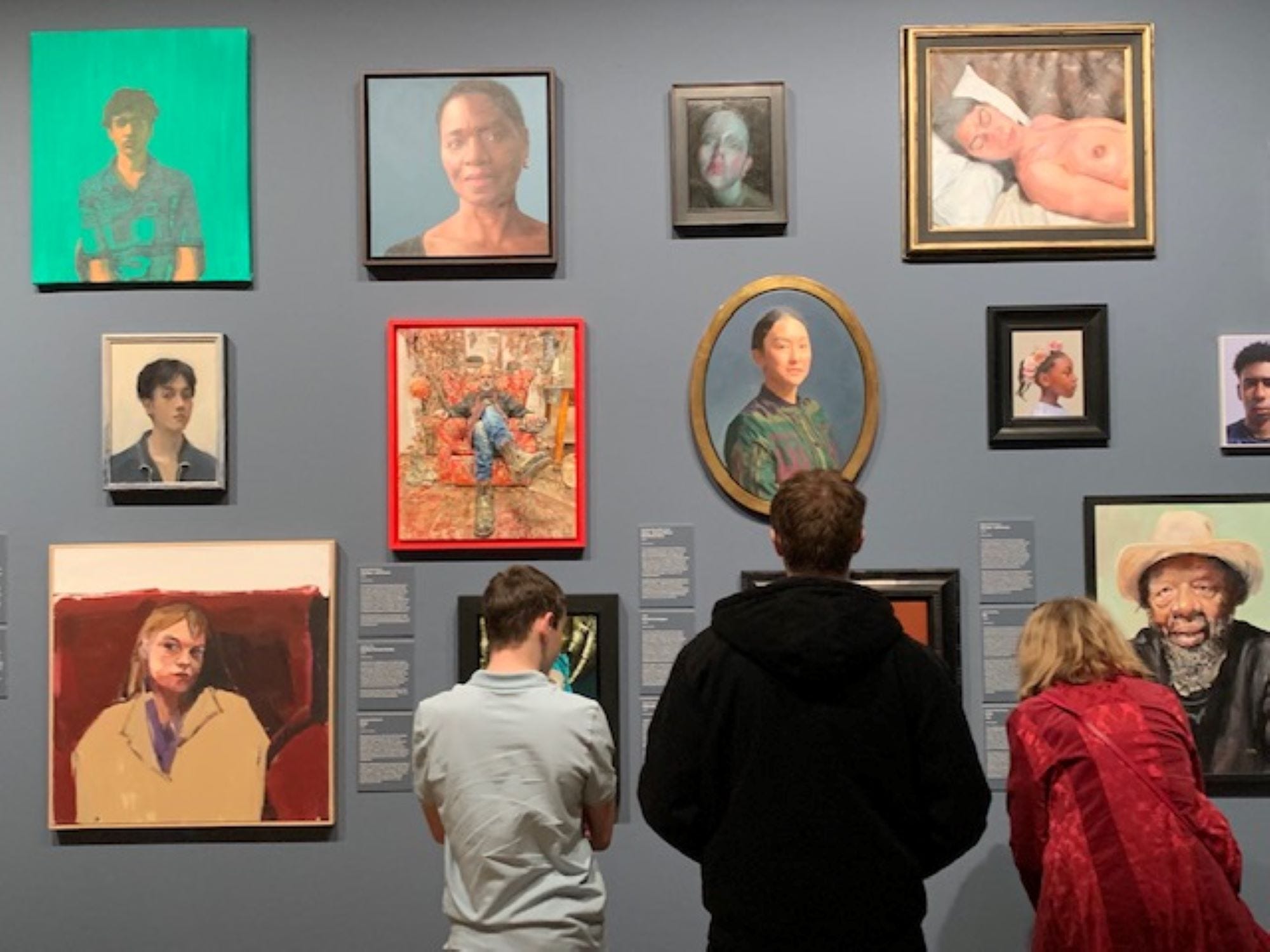
It contains 46 portraits, including the winning submissions, most of which were painted in the last couple of years, and all demonstrating (as if fans of Sky’s Portrait Artist of the Year competition needed reminding) that portraiture is a popular and thriving artform.
There are some sensational paintings in this second room which can seem a bit overwhelming, all those eyes looking out at us searchingly as if to mesmerise the judges.
They, of course, have made their decisions and moved on. Now it’s us, the visitors, who face the intensity of the collective gaze.
Some exhibits have a photo-realistic appeal, others have their subjects emerging from a maelstrom of paint.
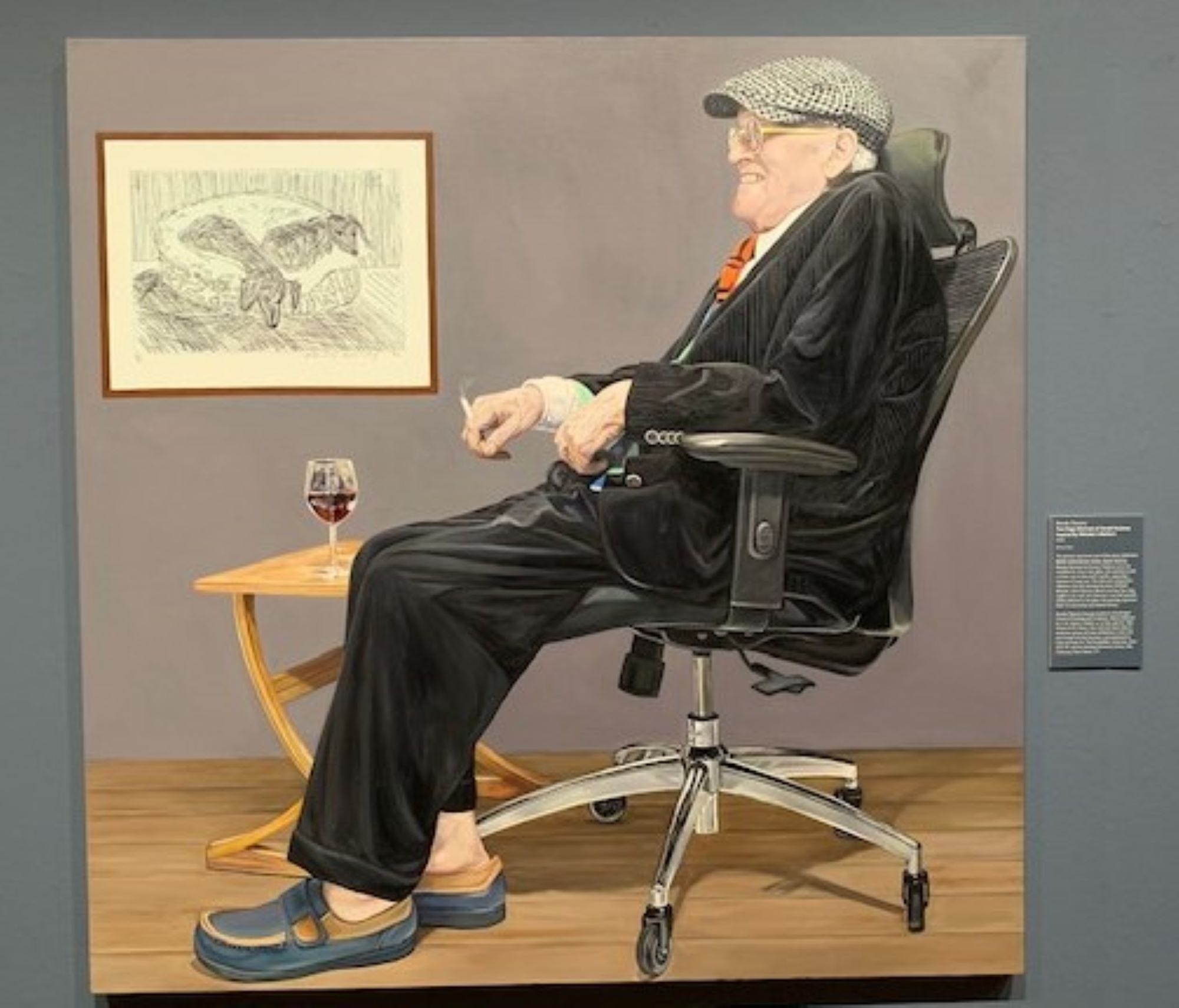
One sitter not eyeballing us from the frame is David Hockney, shown in profile, smiling across the canvas with a fag and a glass of wine (look closely and you’ll see the artist’s face whimsically reflected in the wine glass, reminiscent – suggested Laing gallery attendant Karen – of the homunculi in recent TV comedy drama Small Prophets).
The humour of the painting extends to the title chosen by artist Brenda Zlamany – Two Dogs (Portrait of David Hockney Inspired by Whistler’s Mother). The two dogs can be seen in a wall-mounted picture in the picture.
Two startling works make for an arresting corner, with Thomas Arthurton’s artfully angled portrait of the violinist Jacob Meining, After the Concert, juxtaposed with Xu Yang’s highly theatrical painting inspired by the myth of Leda and the Swan.
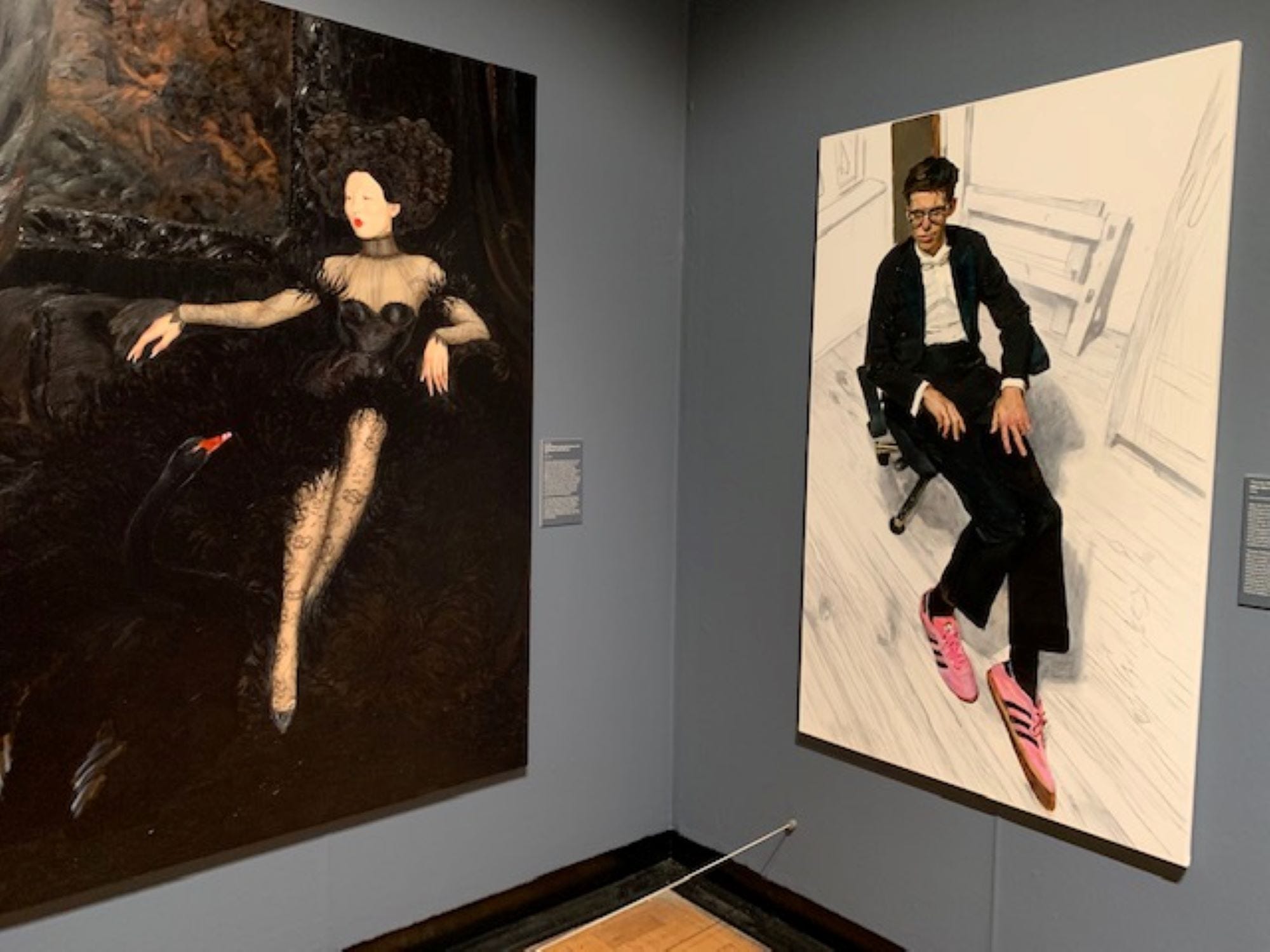
The title’s another mouthful – Tangled Waves: Leda and the Swan with Tang Dynasty Style Make-up.
This was the painting gallery attendant Jenni said she would most like to take home. Karen favoured Li Ning’s eye-catching submission, and not, she swore, because it’s called Portrait of K.
Judges’ decisions are generally finally but rarely uncontroversial and everyone will find their own personal winners from among this vivid and contrasting array of paintings.
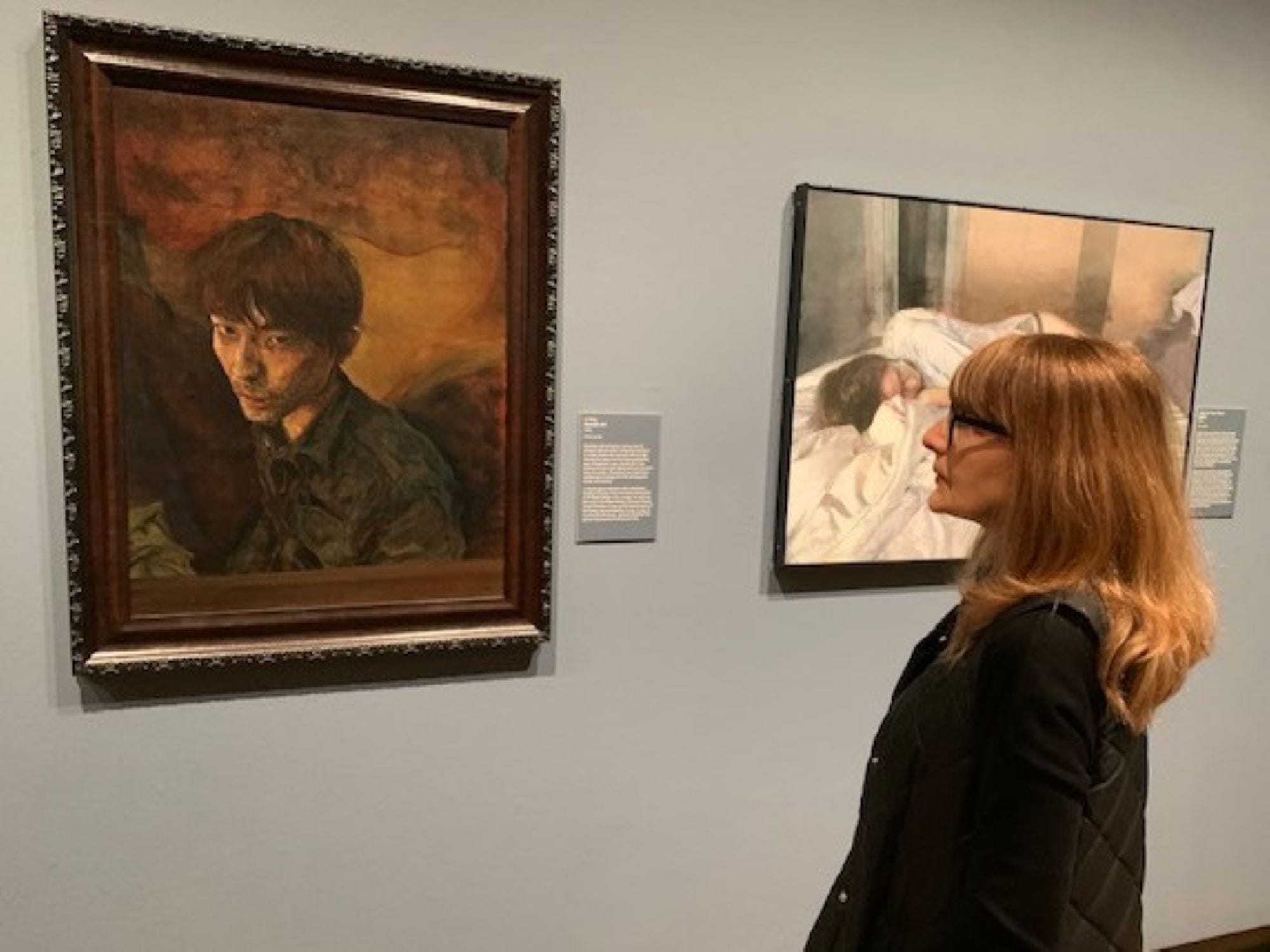
The actual first prize was awarded to Moira Cameron for her 2024 painting A Life Lived, which could hardly be further removed from any suggestion of photo-realism.
Described as an evolution of a self-portrait made at art college, Cameron said of it: “The lines on my face, the subtle shadows, tell a story of time passing, of laughter and worry, of a life fully experienced.”
At least it was she in control of the process, unlike Julia in the Auerbach portrait in the adjoining room.
The judges reported that their attention was grabbed by the bold, non-naturalistic treatment of the figure combined with the vivid colour and use of pattern.
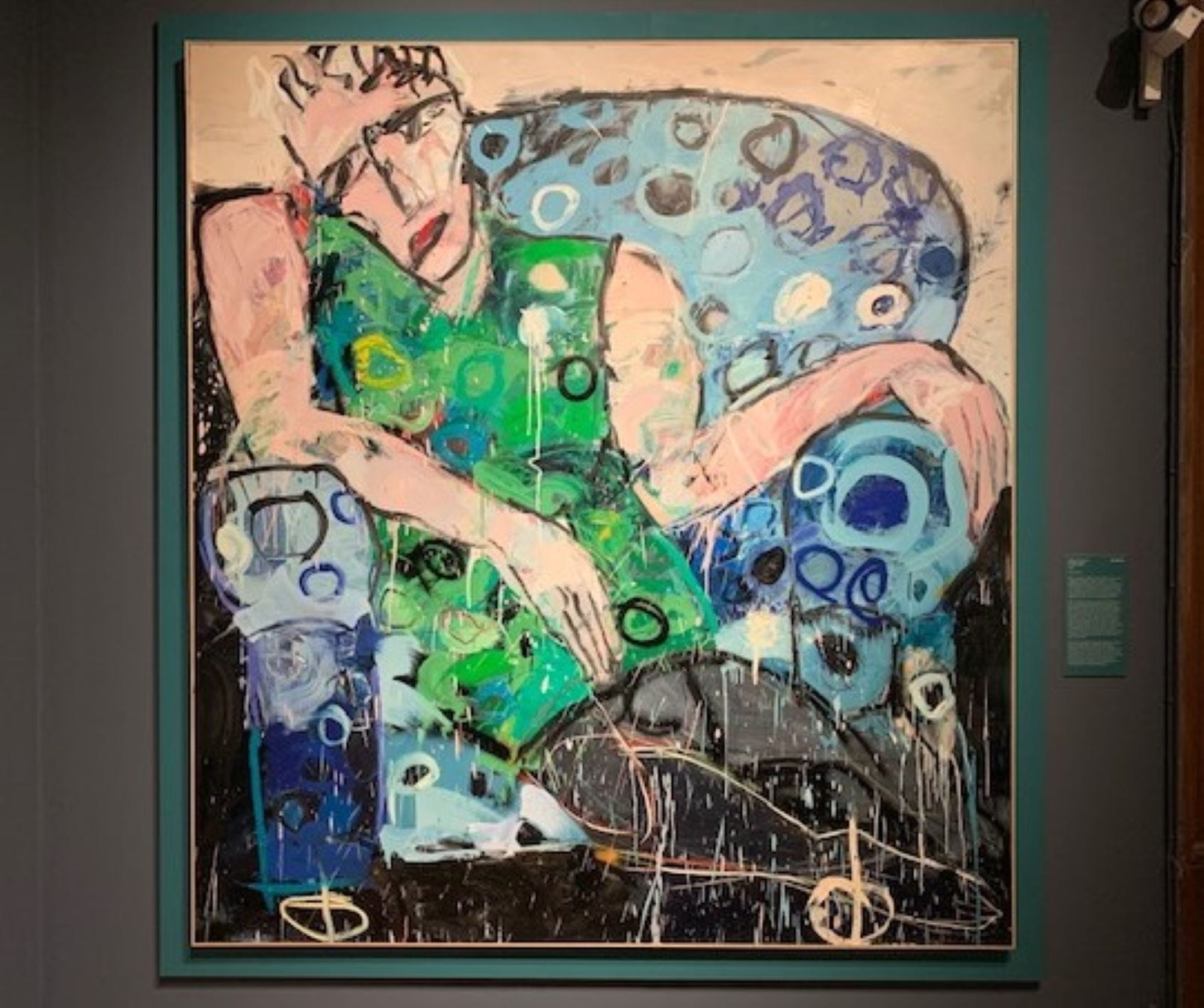
“The technique,” they reckoned, “has an energy, vitality and humour that contrasts with the introspective pose and expression of the subject, creating a compelling tension.”
This is certainly a compelling exhibition. It is on at the Laing to be pored over and debated until September 5. For details of opening times and ticket prices, go to the Laing Art Gallery website.
I love the last three sentences David - nicely diplomatic