

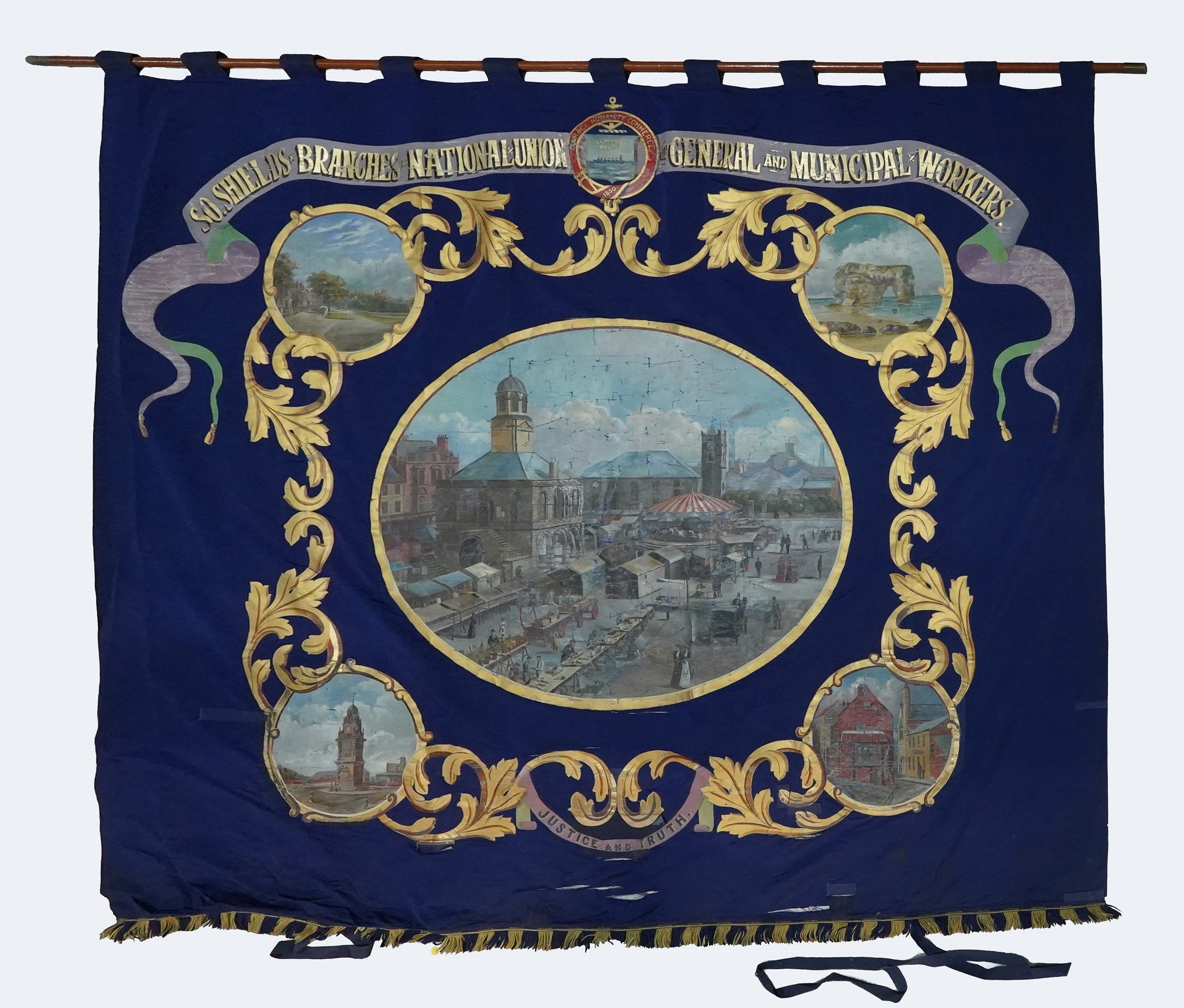
An outstanding example of trade union art and heritage is to be sold on Tyneside.
The dark blue silk banner of the South Shields branch of the National Union of General and Municipal Workers is estimated at £1,000-£2,000 and will be sold by Anderson & Garland in Newcastle on January 15.
The banner features a central illustration of South Shields Market Place, and separate images including Westoe Village, Marsden Rock, the town’s Wouldhave Memorial, Mill Dam with the Customs House tavern and Seamen’s Church, a fully rigged ship sailing past the Groyne lighthouse and pier, and ships unloading, in dock, and being built.
A newspaper report tells how the new banner was unfurled in 1894 at the Free Library in South Shields before “an assemblage of trade unionists”.
“The Mayor unfurled the banner, presenting to the gaze of an admiring audience an emblematic ornament of artistic design.”
It was created by Samuel Peacock of Baring Street in South Shields who, in addition to being a banner maker, was also a dealer in china and an insurance agent.
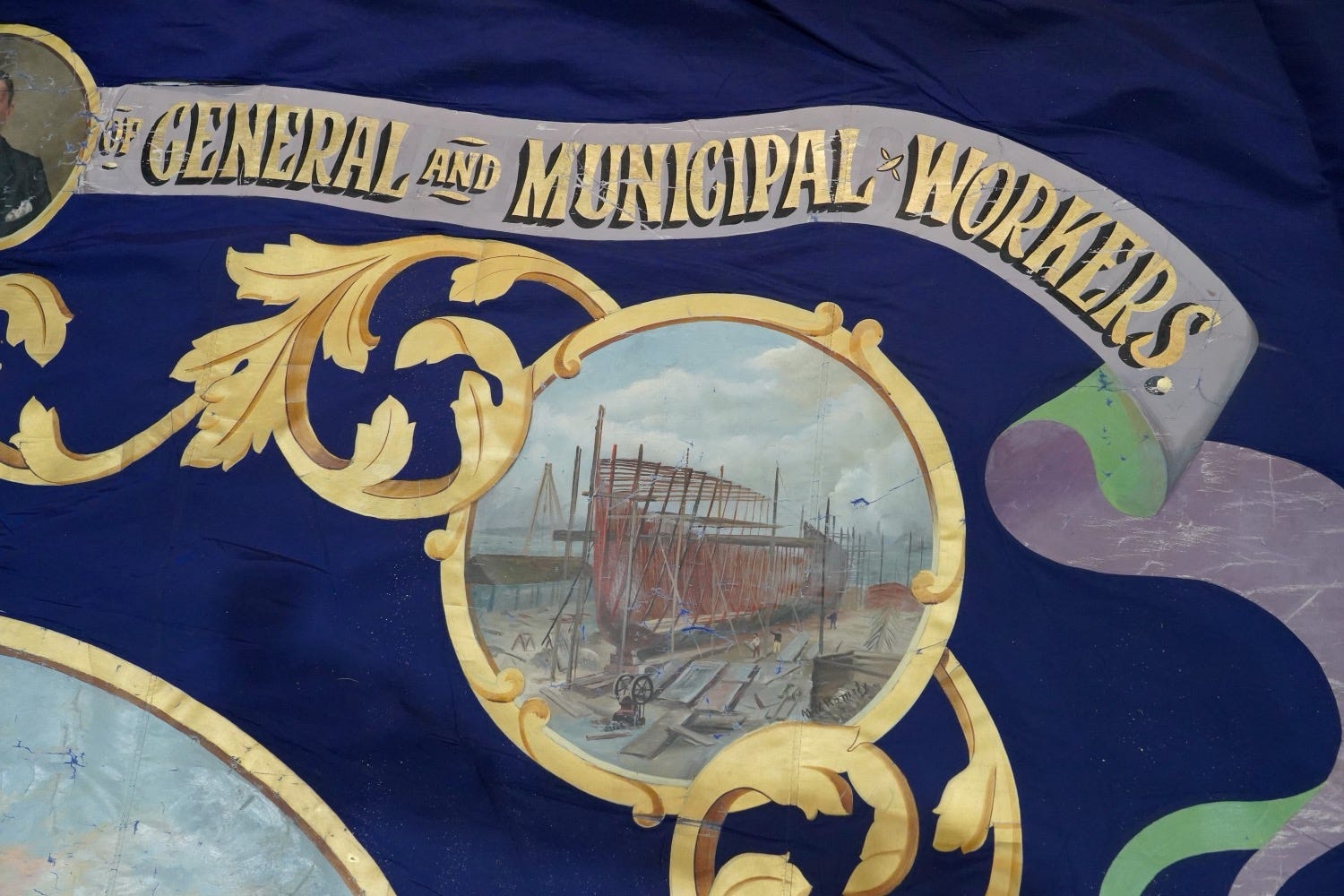
The images were described as being in oils and bordered in gold and were the work of artists John Davison Liddell and M W Ramsey.
Liddell also painted the lavish welcome for the future Edward VII and Queen Alexandra when they sailed up the river to open Albert Edward Dock – now the Royal Quays marina – in North Shields.
The painting, titled The Royal Visit to the Tyne, August 1884, has been newly restored and unveiled as part of the North Shields 800 anniversary.
It is part of North Tyneside Council’s collection and, after being in storage for years, is now on permanent public display at North Shields Register Office.
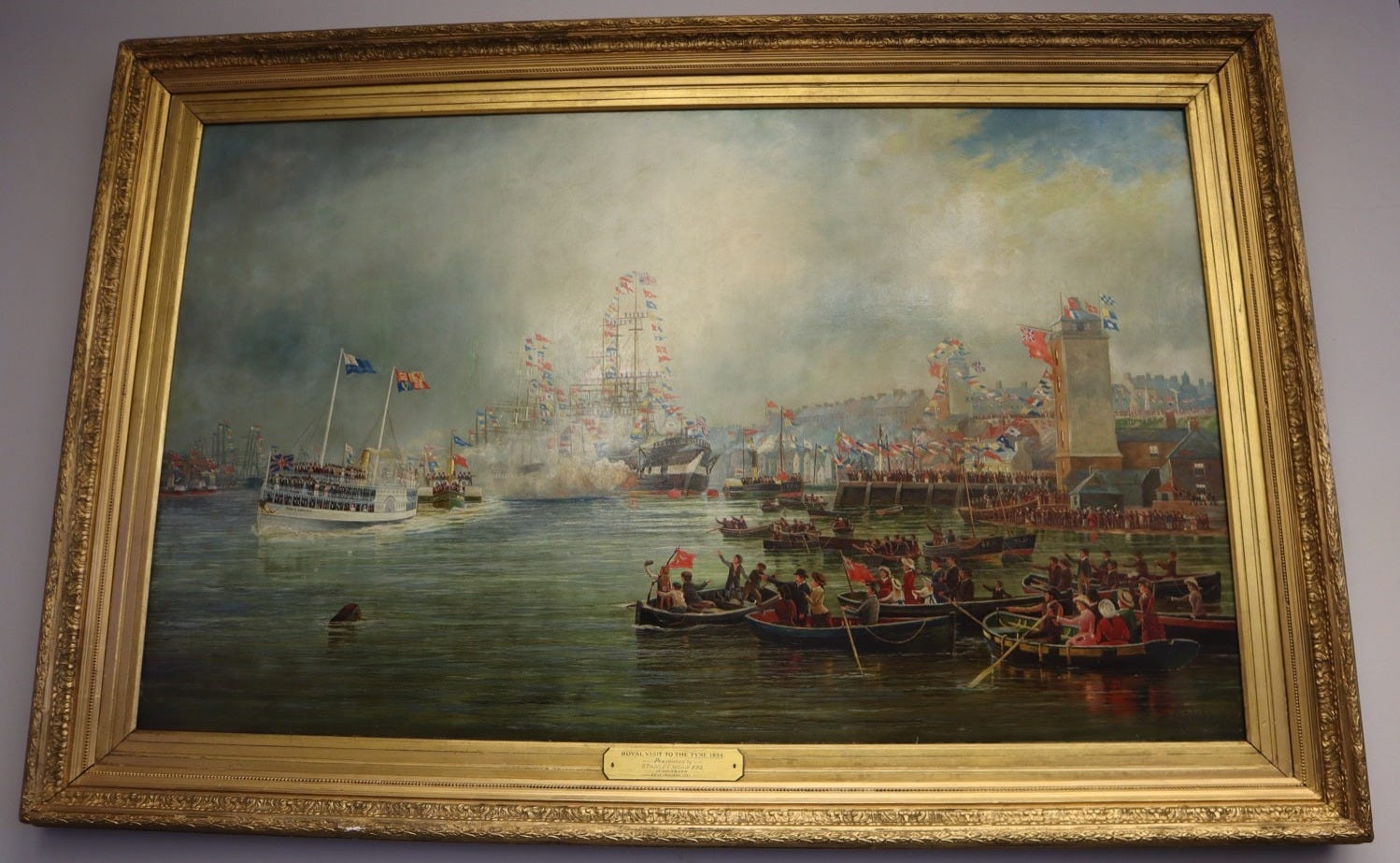
Liddell’s work captures the moment the Royal party, travelling on the steamer Para-e-Amazonas with their sons, reached North Shields as crowds lined the riverbank.
The restoration was carried out by Newcastle art conservator Adrian Swales, with funding support from Rosserk Park Properties Ltd.
Elected Mayor of North Tyneside Karen Clark said: “It is wonderful to see part of our heritage restored and on display. This painting records a proud day in North Shields history.”
Miles Walton, director of Rosserk Park Properties Ltd, said: “We are proud to have supported the restoration of a painting that is so closely linked to the history of North Shields. It is fantastic that this piece will now be accessible for the community to enjoy.”


John Liddell, who was born in 1859 and lived in Grey Street in North Shields, began working life as a tinsmith but became a professional artist in his 20s and made his name as a landscape and marine painter, with works focusing on the tugs and colliers of the Tyne.
An account of the royal visit tells how two grandstands were erected at the dock for the friends of the Commissioners, and two jetties were fitted with seats for the workmen and their friends.
The account goes on: “Companies of volunteers kept pouring in from Tynemouth. South Shields Life Brigade arrived with their ambulance apparatus.
“Drafts of policemen marched down the hillside into the hollow in which the dock is situated. The Coble Dene brass band discoursed sweet music. Crowds of spectators began to collect on the time-gun ballast hill, on the banks skirting the dock, and on the river’s bank.
“Men fought for better positions and crowds rushed to the riverside, some going a step too far and getting a ducking.
“The position of the volunteers on the piers, the galloping to and fro of officers in varied, and in some cases grotesque, uniform, the approach of the Royal steamer, the rushing of the populace to the heights all combined to produce such effect as might be caused by a great battle. The Royal salute with which the company was received emphasised the illusion.”
During their visit the couple stayed for three days at the Cragside home in Northumberland of Lord and Lady Armstrong.