

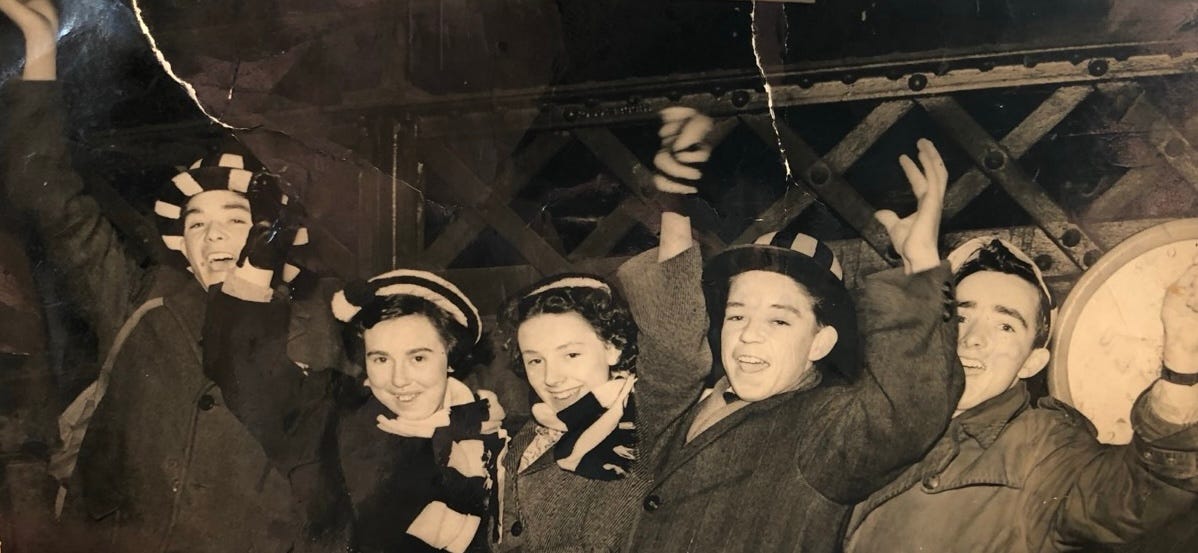
One of the main goals of Professor Stacey Pope has been to give a voice to the female fans who have followed their teams with just as much passion as the men over the decades.
And as a base for her research the Durham University academic could scarcely have a better location than the North East, where football for many is a way of life.
She has talked to women committed to both Newcastle United and Sunderland, some as far back as the 1950s, who have staked their space in a male-dominated arena despite the challenges.
Those challenges have varied from the undercurrent that women fans intrude into a territory traditionally held by men, to being left feeling that their opinions and knowledge of the game are less than male supporters – that they are not “proper” fans.
The latest project by Prof Pope, director of research in the Department of Sport and Exercise Sciences at Durham University, is a pop-up exhibition featuring the experiences, memories and views of black and white and red and white female fans.
Titled Away From Home: The Untold Stories of Women Football Fans, it is co-curated with David Wright.
It can be used in Newcastle or Sunderland sections, or as a combined whole. The Wearside section is currently on show until the end of the season at the Beacon of Light community hub near Sunderland’s stadium after a spell on show in Durham.
Now sociologist Prof Pope is hoping that venues in Newcastle and Tyneside will offer to stage the exhibition.

She is the leading expert on women football fans in the UK and has developed a programme of work examining men’s responses to the growing visibility of women in sport, and issues of sexism and misogyny.
She also leads research on media coverage of women’s football and the England women’s team, has published extensively on fans of men’s and women’s football and is the author of the book The Feminization of Sports Fandom and co-editor of Female Football Players and Fans.
She has given evidence to three UK Parliament inquiries. Her report Women and Football Fandom: Reducing Sexism and Misogyny in Men’s Football and Expanding the Fanbase of Girls and Women puts forward recommendations for how football can be made more safe, welcoming and inclusive for women.
Many of these recommendations have been taken forward in the House of Commons Culture, Media and Sport Committee Safety at Major Sporting Events report.
“Women fans have always attended football matches. For many of the women we spoke to in our research, supporting their team is central to their lives, stirring their emotions and providing unforgettable moments on and off the pitch,” said Prof Pope.
“However, despite the long history of women football fans, their stories remain largely untold and are at risk of being lost, so it has been important to document them for the years to come.

This lack of visibility has allowed negative attitudes to form, meaning women are often still viewed as outsiders or newcomers rather than real and authentic fans.
“We really wanted to capture the women’s voices and tell their stories as loyal, committed and passionate supporters.”
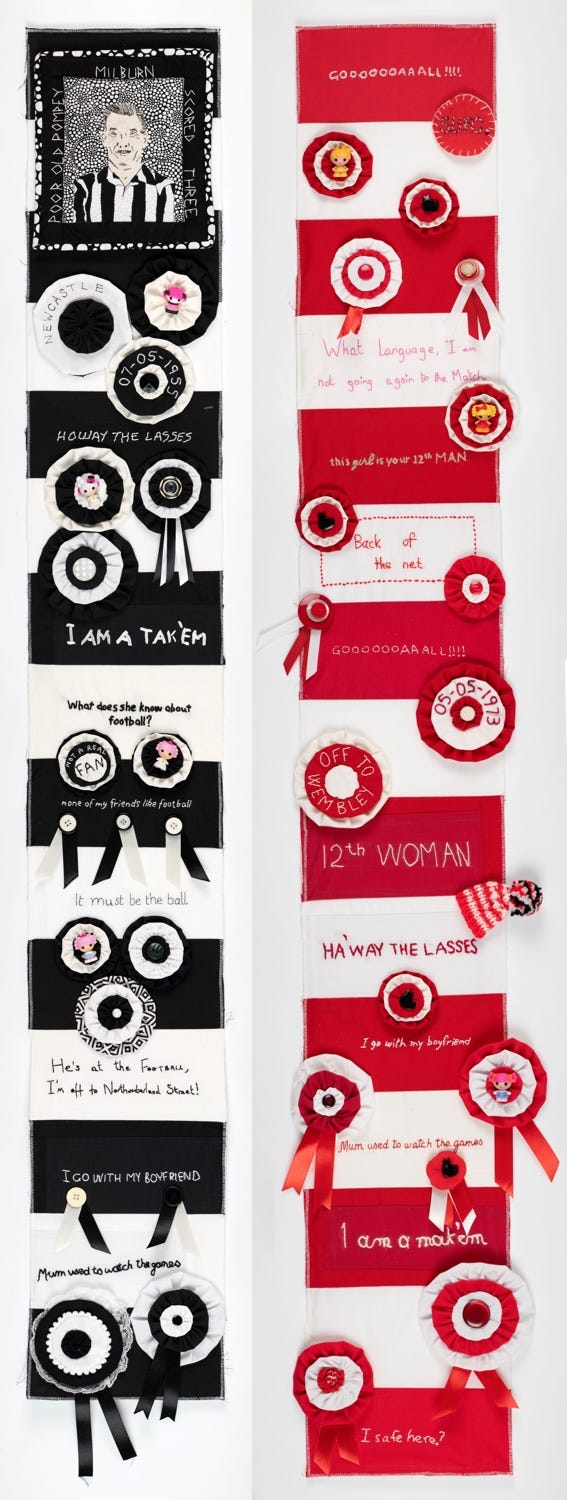
The exhibition includes football scarves made by fans, embroidered pieces by Take a Stitch 2 Durham, an independent group of creative textile artists and stitchers, and a football banner made by dementia-friendly inclusive art group Durham’s Creative Age.
It also recalls when kit was made at home rather than bought. It celebrates the North East women who not only made the rosettes and scarves worn by their husbands, sons, brothers and fathers at the stadium, but who were also fans in their own right.
There is also a mural by artist Nocciola The Drawer which tells the story of how little kicks at the park or in the garden can eventually lead to the world of professional sport.
Memories are scattered over the exhibition. Among the Newcastle participants is Jean, whose father took her to her first game in 1961 as a surprise, not telling her until they were going into the stadium:
“The next I knew, we were outside St James’ Park. And I was going in! I was just in awe of the whole thing. Even then it was a big ground.
“The whole experience was just magical. When I came home, I didn’t stop talking about it for ages. Suddenly to be in there, the cathedral on the hill.”
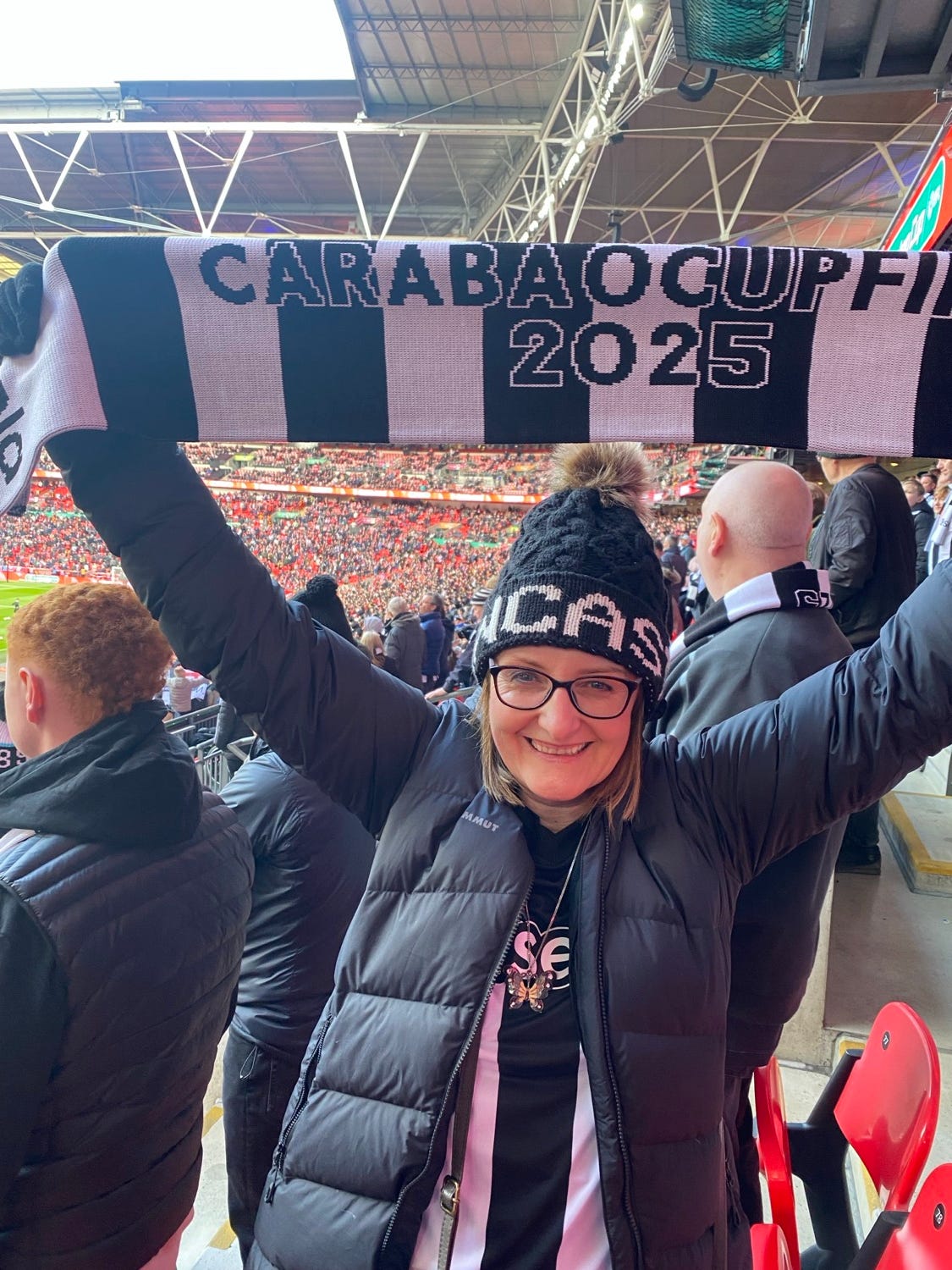
Kathryn, who follows in her mother’s footsteps, says: “I can’t imagine what my life would be like if I took my support of Newcastle, my going to matches, out of it. It’s something I hugely value.”
Other contributions in the exhibition include:
“It’s just part of your life. It’s part of being in the city. It’s an addiction I guess.” Sue
“It’s part of your DNA. Highs and lows. I’ve lost boyfriends over it.” Lynne
“Apart from family, it’s probably the most important thing to me, football.” Jean
“Everyone we know are Newcastle fans. It’s more like a way of life in our family.” Tracey
“Even if there was a nuclear war we would still try and turn up on a Saturday.” Laura and Lynsey
Belinda describes her favourite moment before a Newcastle home game. “That ten to three feeling when you’re in your seats, the ground is filling up. The players come out, they’re playing the song Local Hero, and anything can happen in the next two hours.
“I just love that. That’s just like hairs stand up on the back of my neck. Local Hero is the one.”
Sunderland fans also have their say: Anne, who has been a Sunderland fan since the 1960s and went to her first match aged 13, says: “You know the song, Sunderland ’til I Die? Yes, well, that could be me. That will be me, because I will be.”
Other Wearside fans include Rosie, who has been a supporter since the 1960s: “I’m ashamed to say that it can affect my mood,” and Lynne: “Once you’re a Sunderland fan you are a Sunderland fan for life. It is difficult to get away from it whether you want to or not. They will have to carry me in and carry me out.”
And Christine: “It’s who I am. Take away my football and I’m a lesser person.”
Pam grew up in Sunderland. She started going to watch Sunderland in the 1960s with her friends.
“We stood at the top of the Fulwell End. Four girls, we went, about 11, 12 years old. From then on, I loved it, absolutely loved it. We went for years and years up there, until I went to college when I was 18, but in those seven years we went to every home game.”
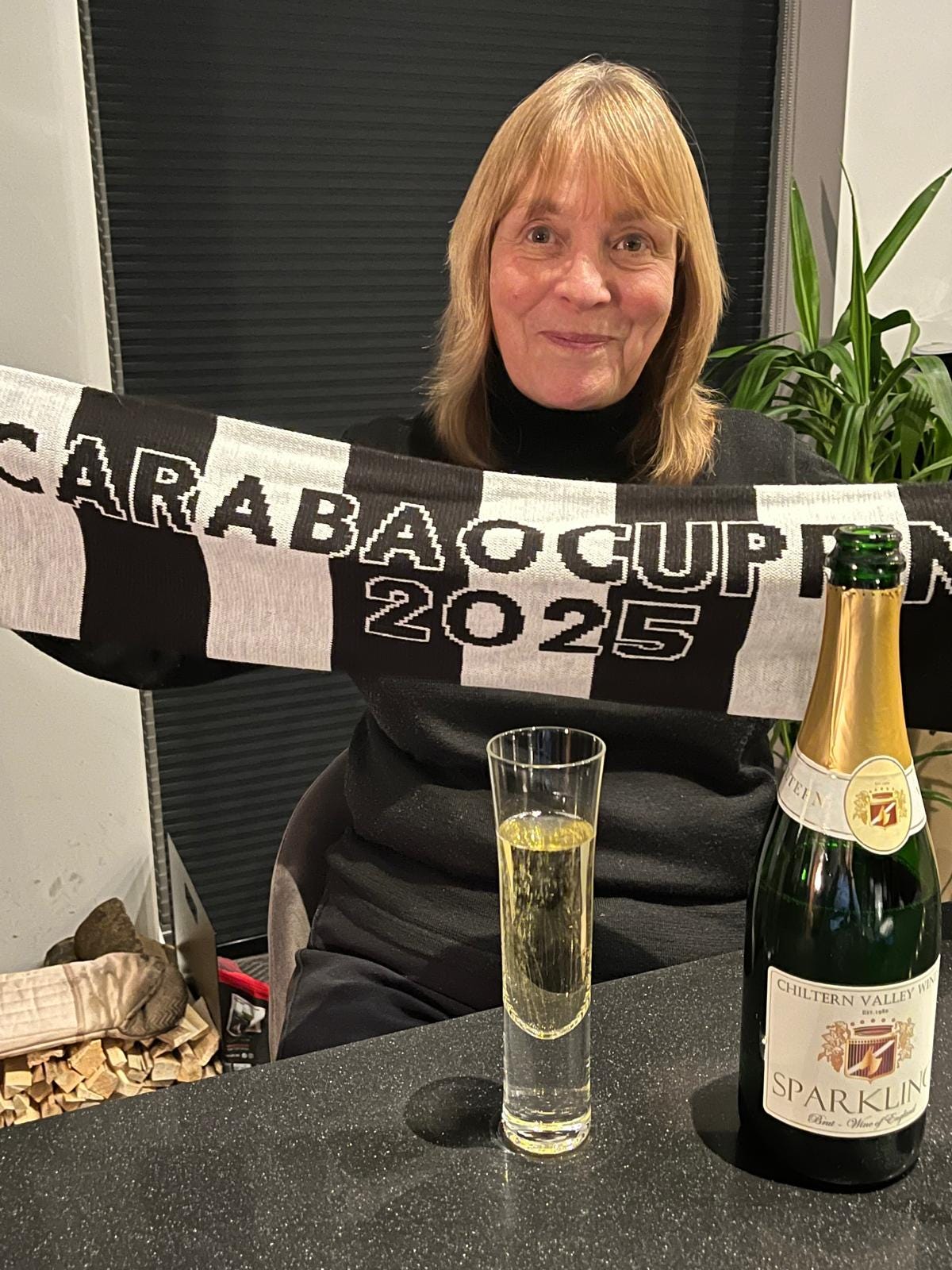
The exhibition is based on research funded by the UKRI Arts and Humanities Research Council, National Lottery Heritage Fund and Foundation of Light.
The stories told by the fans demonstrate how ideas about football fan culture have changed over time, and what it means to be a woman in a space that is often thought to be for men only.
The recent success of England’s Lionesses has brought much more attention to women’s football, leading to a general positive shift in attitudes towards all women in the game, including players, coaches, pundits and fans.
However, the Durham University research has shown that misogyny is still present in football and many female sports fans struggle to be taken seriously.
A Sunderland fan since the 1960s, Mary talked about her experience with negative attitudes. She says: “A few times I would say something, and they wouldn’t take it up or agree, until a man said the same thing.
“Not so long ago there was an objectionable man sitting a few seats along and behind. He said, ‘Oh, you should be at the hockey game.’ I said, ‘Who d’you think you’re talking to?’ Didn’t put me off though.”
Lynsey says: “We hear comments like, ‘What would you know about football? You’re a woman.’ I’ve had comments like that. They wouldn’t dare say it to us now. But I do think there’s an attitude there, definitely. And sometimes I sit and I think, you have no idea what you’re talking about.”
Fiona says: “I do find sometimes where if I’m with my husband, and we’re talking to a couple of men somewhere, people that we know, and we’re talking about the game.
“When I say something, they kind of look at me and then almost as if, ‘Well what’s she talking for?’
I find that irritating. But of course men don’t expect you to be able to contribute.”
The virtual exhibition can be found at stories.durham.ac.uk meanwhile the exhibition is available to hire in full or in sections by contacting david.wright@durham.ac.uk
The next phase of Prof Pope’s work is working with police on how to create a safer and more welcoming football environment for women and girls.
In related news, new research led by Northumbria University highlights the experiences of women who attend men’s football matches, with the aim of making stadiums safer and more inclusive for all.
The Safer Stadiums initiative – run in partnership with Loughborough University, the Football Supporters’ Association (FSA) and funded by the UK’s Research and Development Missions Accelerator Programme – has offered women an outlet to speak out about their match day experiences, including dealing with gender-based violence.
Dr Aarti Ratna, associate professor in the School of Humanities and Social Sciences at Northumbria University, leads the project.
She said: “Everyone involved in football needs to take ownership to make all fans feel safe and at home in stadiums, and on the way to a match. Creating safe spaces outside the stadium, particularly when using public transport, can help women fans feel like they belong and that their fandom is valued as a vital part of football culture.”
While many supporters are at ease in raucous stadiums, having grown up going to games, for some women match days can be a challenging time.
As part of the study, the Safer Stadiums team has run a series of theatre-based workshops across the country including in Newcastle, involving women from diverse backgrounds.
Led by football fan and theatre-maker Hannah Kumari, the workshops helped women explore their emotional experiences of match days. Women fans were also invited to discuss possible solutions to the problems they have faced.
Met my first girlfriend in The Leazes End. 1975. She went to games with her friends. During the long hot summer of 76 I rode my Suzuki GT 185 25 miles up the A19 to go baby sitting with her and on weekends, although I wasn’t qualified to carry a pillion we would ride out to Tynemouth for an ice cream and a cuddle. I overdid it on the Suzuki and burned a hole in the piston. 🔥 Such was my eagerness to arrive.