

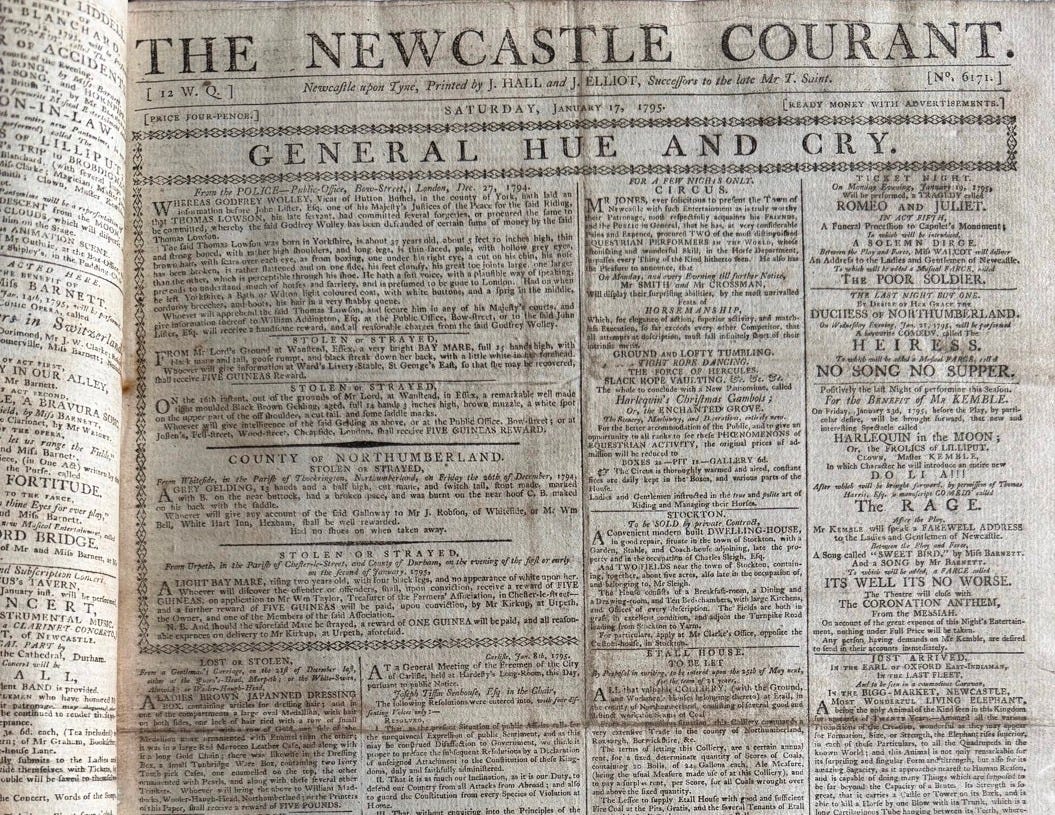
For the Newcastle Courant newspaper of 230 years ago, it was a very big story.
The then sensational exhibiting of a live elephant in the Bigg Market was an early example of the location’s lively reputation for pulling in the punters.
The event is reported in one of a near complete run of 205 bound copies of the Courant, from January 1795 to December 1798, which will be sold on April 15 by Tennants Auctioneers in Leyburn, North Yorkshire.
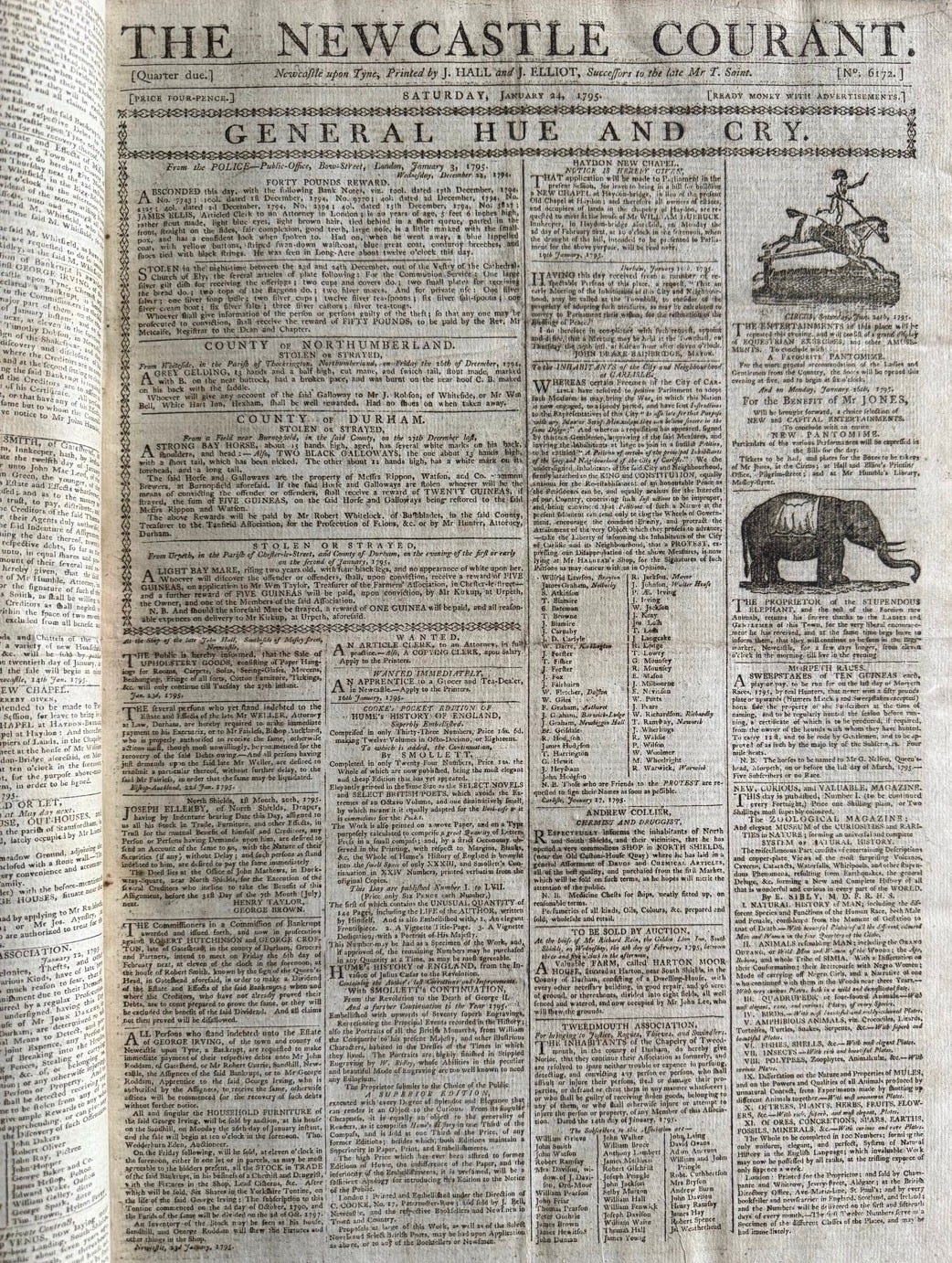
Their pages paint a fascinating picture of life in the North East at the end of the 18th century, from the entertainments on offer in Newcastle to stolen horses, pubs for sale, and concerns over crime and what to do about the poor.
Few if any locals would have seen an elephant, so its Bigg Market presence was a visitor must.
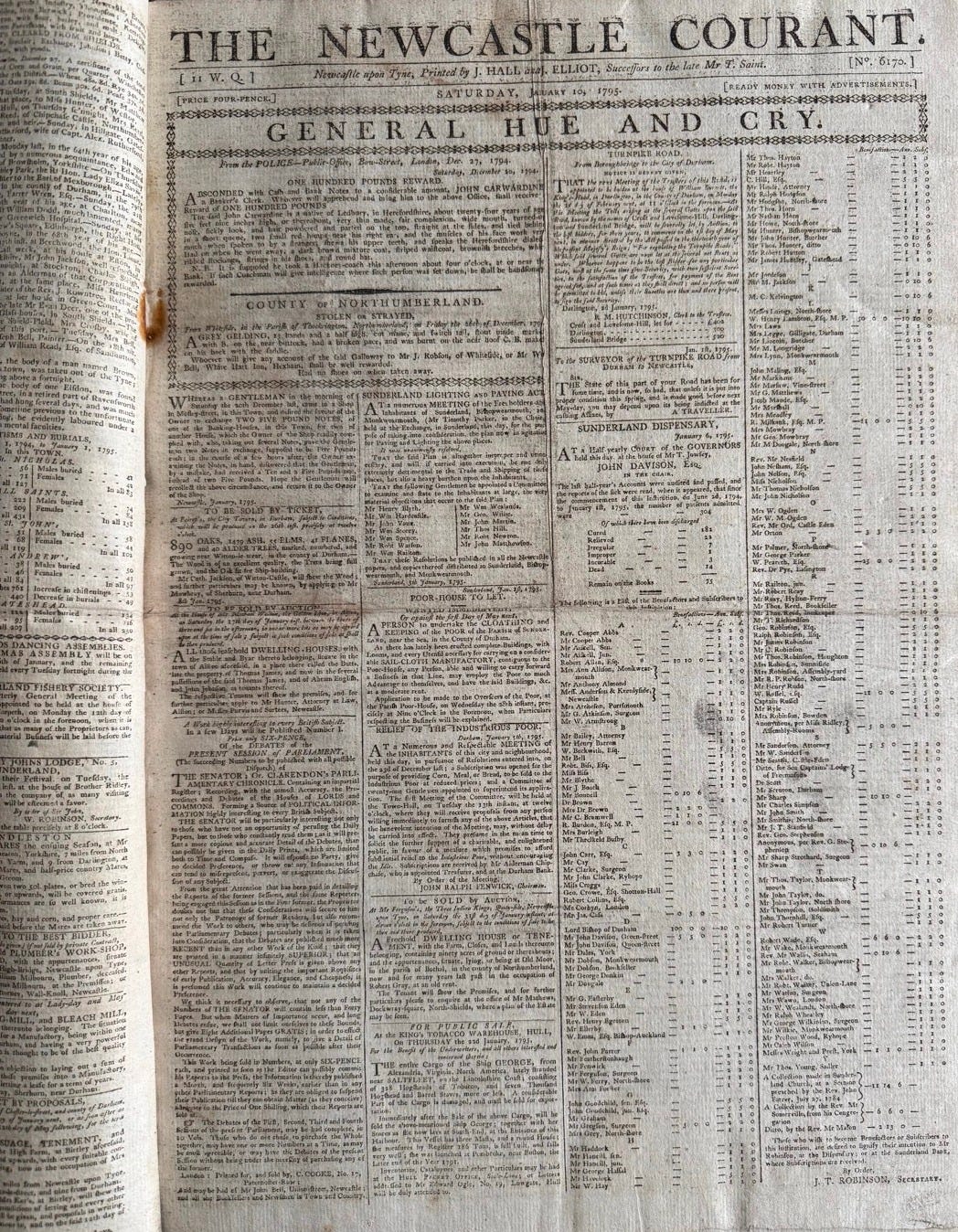
The Courant reported:
In the Bigg Market, a most wonderful living elephant. The animal is not only remarkable for its form and strength but also for its amazing sagacity, as it approaches human reason.
Its strength is so great that it carries a castle on its back and is able to kill a horse by one blow with its trunk, which is a long tube hanging between its teeth. It is not violent except when irritated or discomforted for want of food.
Other theatre entertainment in Newcastle included: “High Life Below Stairs and A Good Natur’d Man featuring the song Let Us All be Unhappy Together. Donald MacLean will perform the Highland Fling after which the performance of the comic opera Peeping Tom with Mr Wilson in the character of a Sandgate Lady.”
Or “By desire of Her Grace the Duchess of Northumberland will be performed a comedy The Heiress to which will be added a musical farce No Song No Supper.”
Or “For a few nights only, a circus. Mr Jones, ever solicitous to present to Newcastle such entertainment as is truly worthy of the patronage of the public that he has at very considerable pains and expense procured two of the most distinguished equestrian performers in the world whose astonishing skill in the Horse Department surpasses anything hitherto seen.
“The circus is thoroughly warmed and aired, constant fires are daily kept in the boxes and various parts of the House.”
The Goat Inn and adjoining coffee house was to let on Bottle Bank in Gateshead, adjacent to today’s Tyne Bridge and Hilton Hotel. Take a look around the buildings which offered a bar, servants’ hall, kitchen, parlour, dining rooms, seven lodging rooms, coffee room, stables, hay loft with ostler’s room above.
The Star and Garter was also for let in Tynemouth, with stables and a coach house.
Under the heading Poor House to Let, applications were invited from “a person to undertake the cloathing (sic) and keeping of the Poor in Sunderland”. Buildings had recently been erected with looms and “every utensil necessary for carrying on a considerable sail cloth manufactory contiguous to the Poor House.
“Any person wishing to carry out a business in that line may employ the Poor.”
Another report headlined Relief of the Industrious Poor informed readers of a “numerous and respectable meeting” in Durham at which a subscription was opened to provide corn, meal and bread to be sold to the industrious poor at reduced prices.
The committee also “presume to solicit the further support of a charitable and enlightened public to afford substantial relief to the industrious poor without encouraging the idle.”
Life in Chester-le-Street seems to have been a risky business, with a report on the area’s Farmers Association for Prosecuting Felons which was offering “ample rewards to such of our servants shall be active in detecting and apprehending thieves committing depredations upon our property.”
There was also the Chester-le-Street Association for Bringing to Justice Rogues and Thieves, offering a “handsome gratuity to any person who shall give information on oath against any offenders on conviction.”
The Courant was launched on August 11, 1711, and continued to be published every week on Saturdays. It was sold in 1832 for £8,000.
The Courant collection is estimated to reach £150-£250 at auction.