


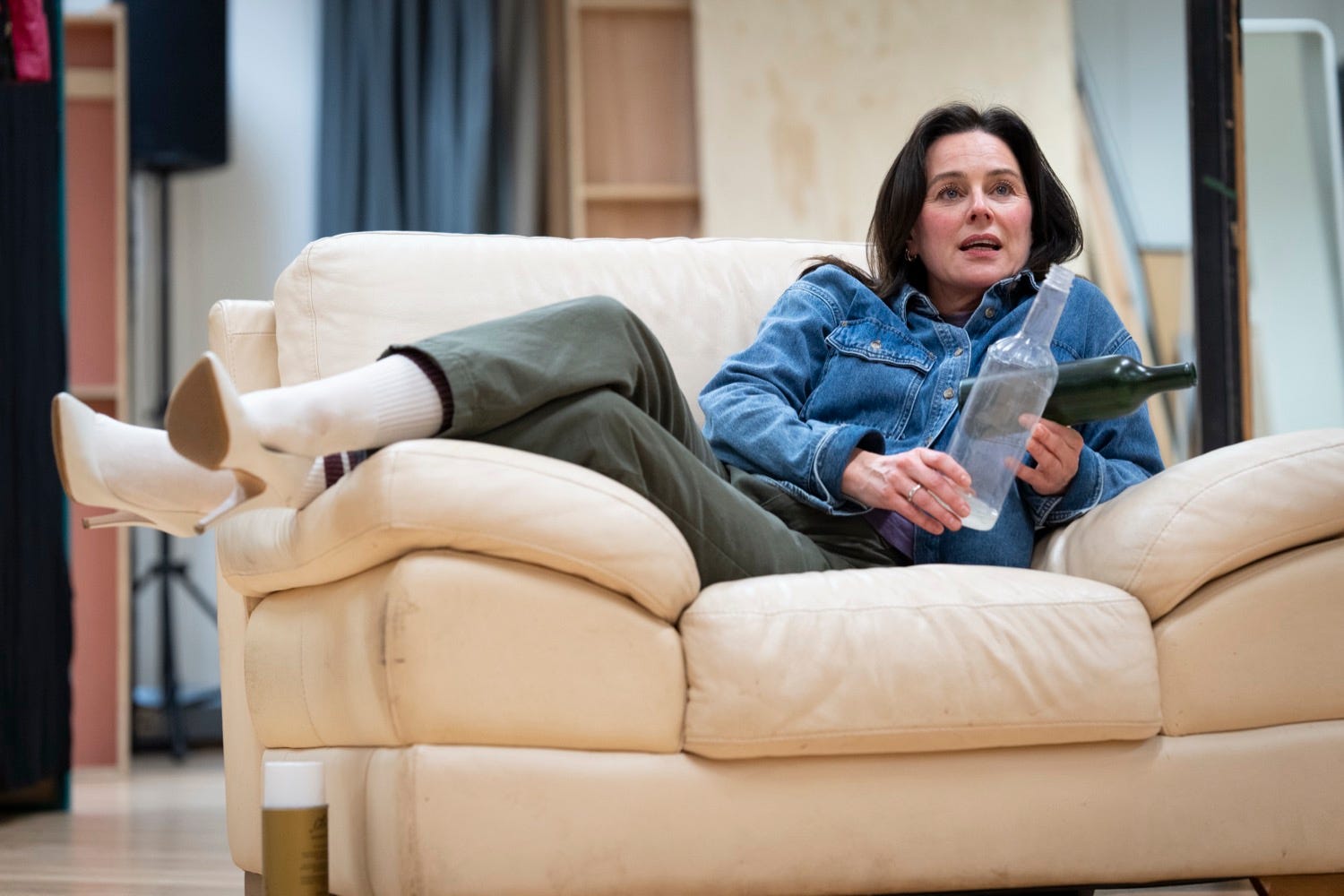
There’s a common thread running through some of Jill Halfpenny’s most memorable stage characters.
“I seem to have made a career out of playing characters that talk a lot, and talk a lot to themselves,” she laughs.
Such is their propensity for dominating a conversation that, even when she reaches a gap in the dialogue, she finds herself wondering whether it’s her cue to start talking again.
“They’re a bugger to learn these parts, but then when you do learn them, they can be incredibly fun.”
Mari Hoff, the gloriously indiscreet, permanently motormouthed mother in Jim Cartwright’s The Rise and Fall of Little Voice, is the latest addition to a collection which includes Beverly from Abigail’s Party and Helen from A Taste of Honey.
(Mari and Beverly, incidentally, share more than a tendency to dominate proceedings – both roles were originated on stage by Alison Steadman.)
Taking on Mari, reckons Jill, is like running two marathons. “She’s like a sort of fireball of energy, and she never stops.”
We’re talking as rehearsals for the National Theatre’s new production of Cartwright’s 1992 play are approaching the full run-through stage, with a few weeks’ worth of discoveries about Mari already under Jill’s leopard-print-hugging belt.
And while I suggest there must be a great deal of fun to be had playing someone quite so monstrous, Jill is reluctant to let the description go unchallenged.
“I feel like I’ve played a few characters in the past where there’s been a sort of questionable or a very complicated relationship between a mother and a daughter, and I have to say I always feel like the mother gets all of the heat and no one ever sort of says, ‘Well, where’s the father?’ or ‘What happened?’
“Absolutely, she isn’t great a lot of the time. She also doesn’t take accountability for herself, but she’s a bit of a victim of her circumstances… I think it’s just much more complicated than, ‘Oh, she’s just a bad person’.”
For those unfamiliar with the play – or the 1998 Oscar-nominated film starring Jane Horrocks, Brenda Blethyn and Michael Caine – Mari’s daughter finds refuge from her mother’s considerable volume in her bedroom, listening to her late dad’s treasured record collection.
While barely able to make herself heard in conversation, Little Voice can summon the voices of Judy Garland, Shirley Bassey and Billie Holiday with astonishing accuracy.
When Mari’s latest boyfriend, Ray Say, discovers what she can do, the prospect of a payday threatens to put an end to her sanctuary.
For Jill, the pleasure of playing someone like Mari lies in getting to grips with what drives her behaviour. “I think I just always try to understand why somebody’s got to that place,” she says.
“It would be quite a sort of uncreative thought to just say someone’s just a t**t.”
An approach to character development which might also serve us all quite well in our dealings with other people, we agree.
Since making her professional TV debut in the first series of Byker Grove in the late eighties, Jill has covered much of the British television landscape, lifted the Strictly Come Dancing glitterball trophy and picked up an Olivier Award.
But working at the National Theatre has remained an ambition unfulfilled. Until now.
Having spent plenty of time in its auditoriums over the years, she’s enjoying the sociability of working in a building housing three theatres, bumping into friends from other productions over lunch and catching up in the bar after rehearsals.
And then there are the evenings nobody could have predicted.
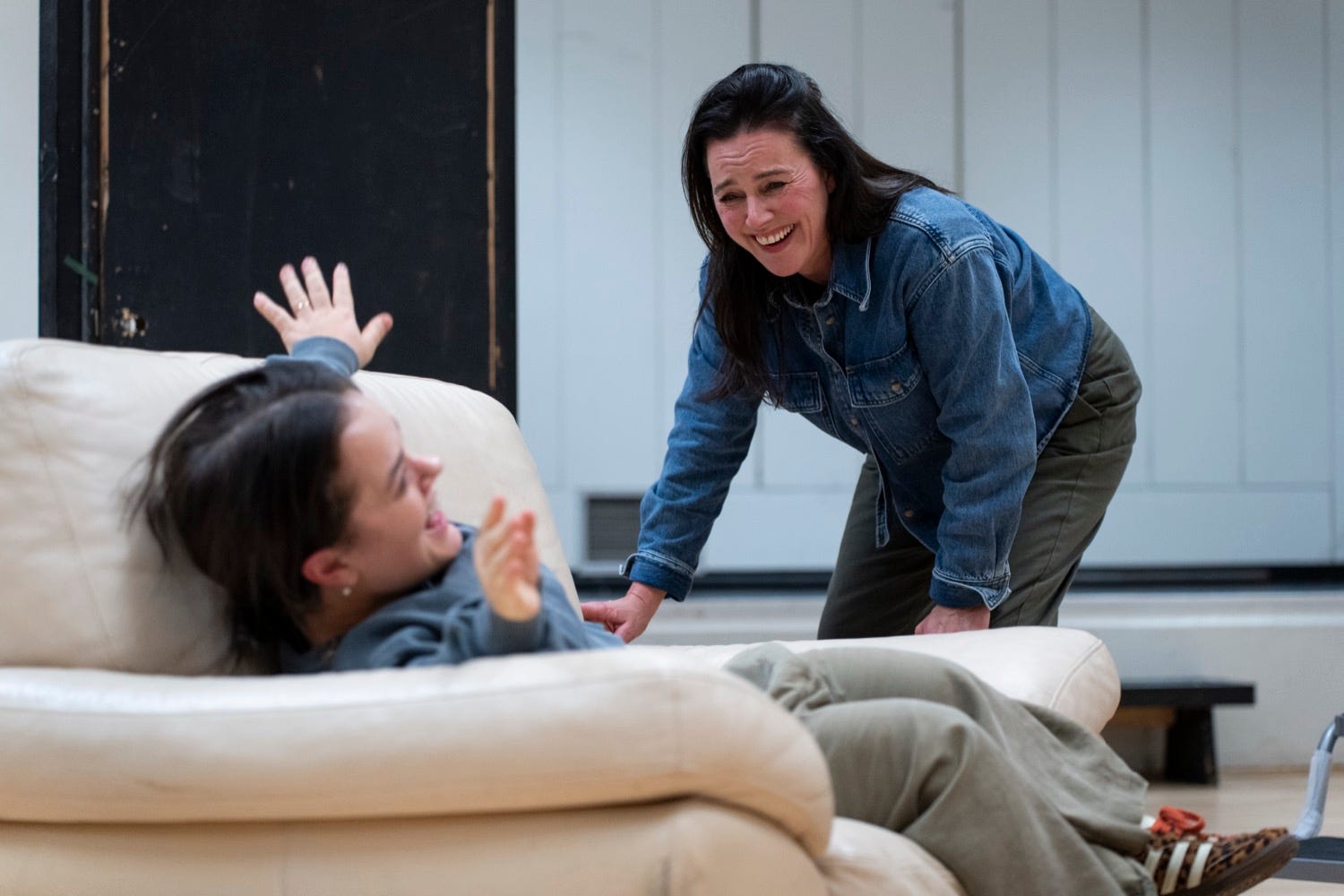
Fellow cast member Paul Chuckle, whose casting as club owner Mr Boo raised a few eyebrows, recently did a Friday night DJ set in the National’s Understudy bar.
“Just looking around, Paul’s on the decks, and we’re all jumping up and down, dancing to Steps. I was like, ‘Yeah, didn’t have that on my bingo card.’”
As Jill points out, Paul was earning his stripes on the club circuit of the 1970s long before the Chuckle Brothers became children’s television favourites – experience which makes him a rather inspired choice for Mr Boo.
Directed by Robert Hastie (Standing at the Sky’s Edge), the production stars Francesca Mills, whom Jill describes as “just brilliant, and the biggest ball of positive joy you could ever meet”, in the title role. Daniel Ryan plays would-be showbiz impresario Ray Say, with Beverly Rudd as Mari’s friend and neighbour, Sadie.
While audiences may be familiar with previous incarnations of Little Voice, Jill says Cartwright is a great advocate for bringing something new to his work.

“It’ll have our own flavour, and Jim is brilliant like that because, I mean, I don’t know how many productions of Little Voice he has actually seen, but I think he understands that each time you do it, it’s like, ‘What else can you bring?’ or ‘What could be new or fresh about this?’ or ‘How can we see it sort of through slightly different eyes?’
“So hopefully, if you’ve already seen it, you’ll see ours and you’ll think, ‘Oh, actually, that felt different to the one I’d seen before.’”
The arrival of Little Voice rounds off a year which has given Jill a satisfying and surprising balance of stage and screen work.
Having made noises to her agent about wanting to do some good theatre, she spent the spring starring in Noël Coward’s Private Lives at Manchester’s Royal Exchange.
“I didn’t predict that I would sort of bookend my year with Private Lives and then Little Voice,” she says. “And then I did a nice telly job in the middle of that as well.”
The drama in question, Mavis Eccleston, tells the true story of a woman who stood trial for murder following a suicide pact with her terminally ill husband.
Jill plays the couple’s daughter-in-law and describes the performances of Penelope Wilton and Jonathan Pryce in the lead roles as heartbreaking. She expects the drama to air in the spring.


Before that, though, there’s a run at the National’s Dorfman Theatre, where Little Voice will play from December 2 until January 23, followed by seven weeks on the road.
The production is the first to tour under National Theatre Nationwide, a partnership with theatres across England designed to broaden access to the National’s work.
Newcastle Theatre Royal will be the first stop.
“When we go to Newcastle, you’re gonna see the production that has literally just been in the Dorfman at the National,” says Jill.
“You’re not gonna see a different cast. You’re not gonna see a scaled-down set. It’s the same production.
“I love the fact that we’re taking it out almost immediately off the back of the London run,” she continues. “I think that’s a really great initiative. I’m dead proud to be part of it. I know we’re the first company that are going to be doing it, and hopefully in the future there’ll be a lot more of that.”
As Jill points out, if the National Theatre is to be everyone’s theatre, audiences shouldn’t always have to fork out for train tickets and a hotel stay in London to see its work.
With Arts Council England research showing that the number of plays touring in England has fallen by 64% since 2019, Jill - a patron of Friends of the Theatre Royal - says the appetite for The Rise and Fall of Little Voice in Newcastle – judging by advance ticket sales – is particularly heartening.
“That’s great to see. I love the fact that it’s thriving,” she says.

Having moved back to the North East during the pandemic and settled in Tynemouth, Jill will have the rare luxury of heading home after a performance when the tour reaches Newcastle.
There was a family flavour to this year’s Sunday for Sammy shows, with Jill taking to the stage alongside her niece, Chelsea Halfpenny, and sharing the bill with her son, Harvey, and his fellow SA Performing Arts students.
Perhaps surprisingly, Jill hasn’t performed at the Theatre Royal since the 2006/07 pantomime, Jack and the Beanstalk – which happens to be this year’s panto too.
Two decades is a long time to wait for Jill Halfpenny to return to Newcastle’s grand stage at the top of Grey Street. Fortunately, she’s coming back with plenty to say.
The Rise and Fall of Little Voice plays Newcastle Theatre Royal from February 3 to 6, 2027. For tickets and further information, visit theatreroyal.co.uk.